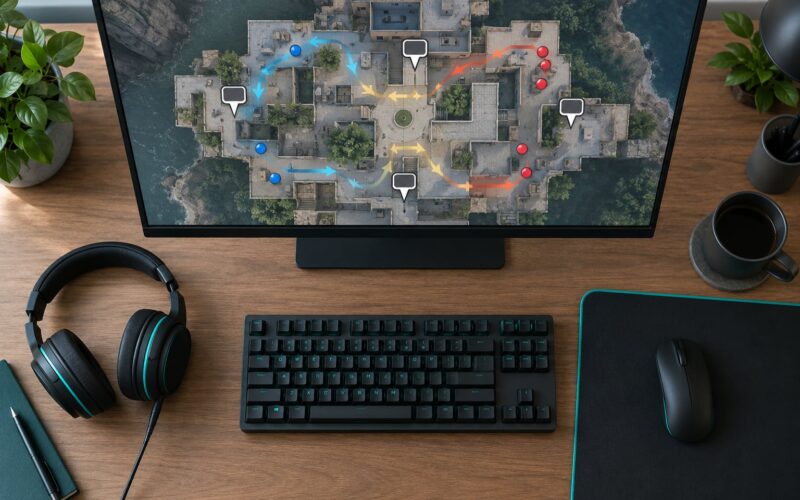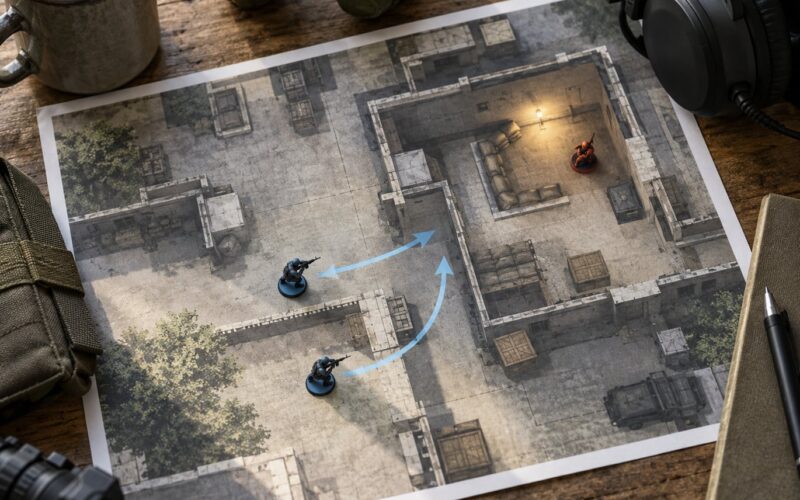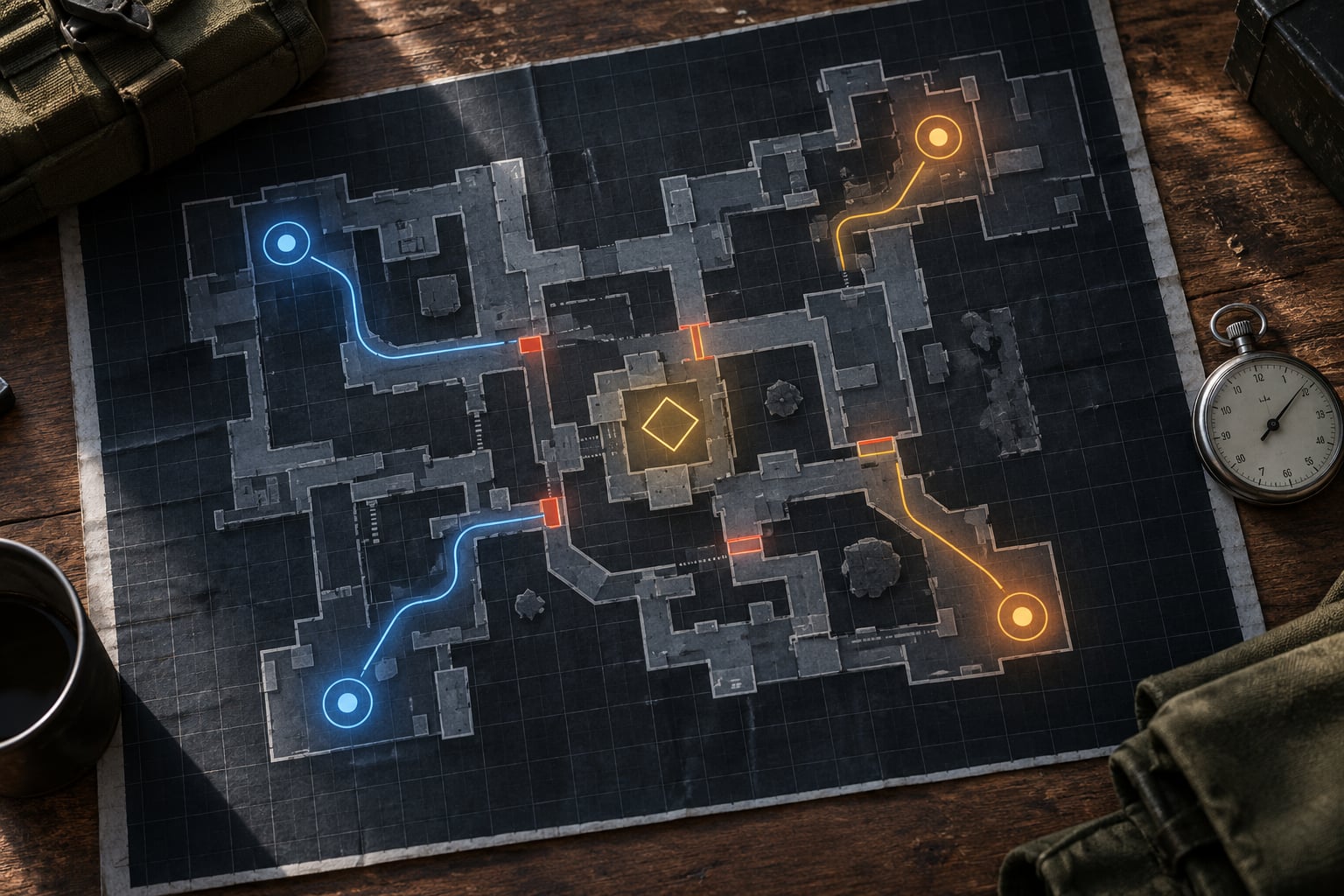
Learning a new map fast comes down to active recall on a spaced schedule, not staring at labelled screenshots. In competitive games it means being able to name any position, name the routes that reach it, and say where opponents will appear, all without opening the map. Two or three focused sessions get a fresh map to round-one usable; a week of short daily drills gets it to competitive.
The uncomfortable part is that almost everyone learns the wrong way. They open a labelled top-down image, study for twenty minutes, feel good, then play six matches and remember nothing. The image never sticks because you built recognition, not recall. Walking the routes yourself, out loud, with a stopwatch, is what turns a map into something your hands know.
A note on scope: this is about game maps. If you meant physical or world maps, the toolkit is different — scale, symbols, grid references and orientation first — and the FAQ below points you to that answer.
Map knowledge is the cheapest advantage in competitive games. It turns enemy positions into information before contact happens, it cuts your reaction time because you already know what belongs there, and it lets you pick fights instead of stumbling into them. None of that depends on your raw aim. A player with average mechanics and strong map awareness beats a player with great mechanics who is always surprised.
Table of Contents
- 1What You Need
- 2Step-by-Step: How to Learn a New Map Fast
- 31. Set Three Learning Goals Before You Start
- 42. Learn the Map’s Big Landmarks First
- 53. Trace the Main Routes Between Every Important Area
- 64. Mark Spawn Points, Objectives, and Escape Routes
- 75. Learn Where Fights Usually Happen
- 86. Test Your Memory Without Looking at the Map
- 97. Apply the Knowledge in a Real Match
- 10Common Mistakes
- 11Frequently Asked Questions
- 12How long does it take to learn a new map?
- 13Do I need to memorize every callout?
- 14Should I learn one map at a time or rotate through the whole pool?
- 15How do I study while still playing ranked?
- 16What should I focus on in shooters versus MMOs?
- 17How do I remember a map after a long break, or after a rework?
- 18Conclusion: What to Do First
What You Need
You need four things, and none of them cost money. Start with access: the game itself plus whatever map preview, custom mode or practice range exists. Some games give you a full top-down layout outside a match. Extraction and survival shooters deliberately do not, so for those, your walkthrough time inside a raid is the only study time you get.
Second, a notebook or a text file. One page per map, divided into landmarks, routes, and danger spots. Pen and paper beats a screenshot folder because writing a name by hand encodes it harder.
Third, a stopwatch. Ten minutes is the right unit for most drills. Unbounded practice time is the main reason map study never happens.
Fourth, one or two low-pressure sessions. Deathmatch, bots, a private server, a casual mode, or a custom lobby where dying costs you nothing. You cannot test routes while being punished for standing still, and you will not learn callouts while spectating someone else.
Step-by-Step: How to Learn a New Map Fast
Run the seven stages below in order. The order matters because each stage depends on the one before it — landmarks give you the frame, routes give you movement, angles give you fights, and recall testing tells you whether any of it stuck.
1. Set Three Learning Goals Before You Start
Write down three things before you load the map, and only three. A good set: every spawn location, the fastest route between each pair of objectives, and one escape route for each place you can die. Three goals you finish beats twelve you abandon halfway.
This constraint is the answer to the most common complaint in map-learning threads. A new player on r/LearnCSGO described feeling “easily overwhelmed by learning all the lineups per map” — and the advice that actually works is chunking, whether that is one map, or one area of one map. Pick a scope you will finish this week.
2. Learn the Map’s Big Landmarks First
Before callouts, find five or six large permanent features: a tower, a clock face, a red container, a broken staircase, a lake. These become the bones of an internal map. Everything else hangs off them.
Name each one in words you would actually use in a match. Say it aloud on the walkthrough. A landmark only counts once it can anchor your position in the dark with no map open.
3. Trace the Main Routes Between Every Important Area
Connect spawn points, objectives, shops, safe zones and the busiest lanes into a small number of repeatable routes. Most maps have roughly five that matter. Note the running time for each one, because speed later often beats accuracy in a rotation.
The same forum thread that flagged overwhelm had the useful instinct in its answers: stick to one area at a time, such as a single site, rather than the whole map at once. Do that, then link it to the next area.
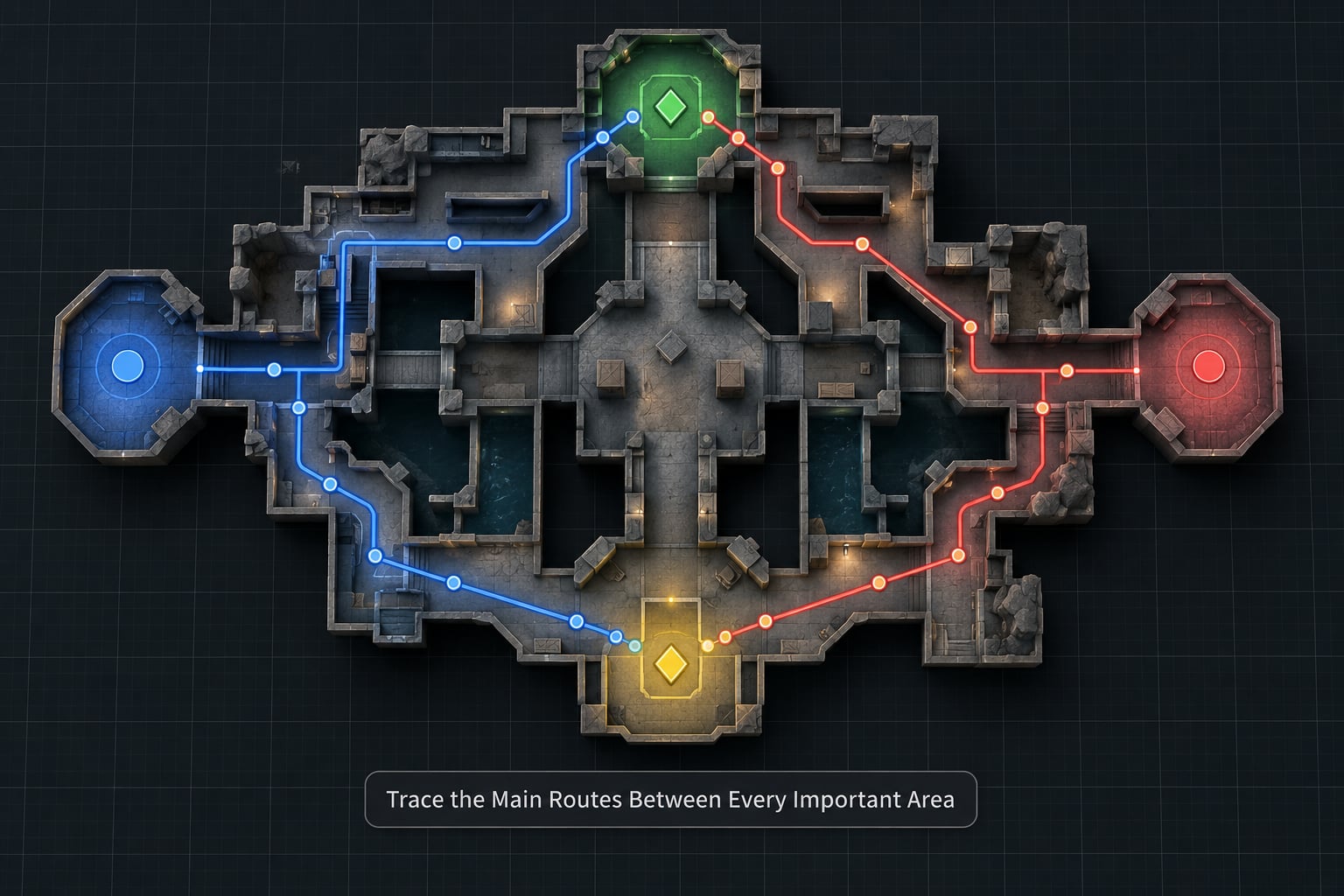
Walking the route is the part people skip. Watching a walkthrough video teaches you the route; walking it teaches you the route plus your own timing, your own jump spots, and the corners you cannot see from the outside view.
4. Mark Spawn Points, Objectives, and Escape Routes
These are the locations you need to recognise instantly, and they are the first thing most players skip. Draw each spawn as a dot on your page. Write the countdown or spawn-protection rule if the game has one, since that changes whether a spawn is safe to fight in.
For every objective area, note the cover you can use, the sightlines into it, and the choke points enemies must pass. Then write your fallback path — the door, connector or window you leave through when it turns bad. A fallback you have chosen calmly is worth several extra seconds of reaction time.
5. Learn Where Fights Usually Happen
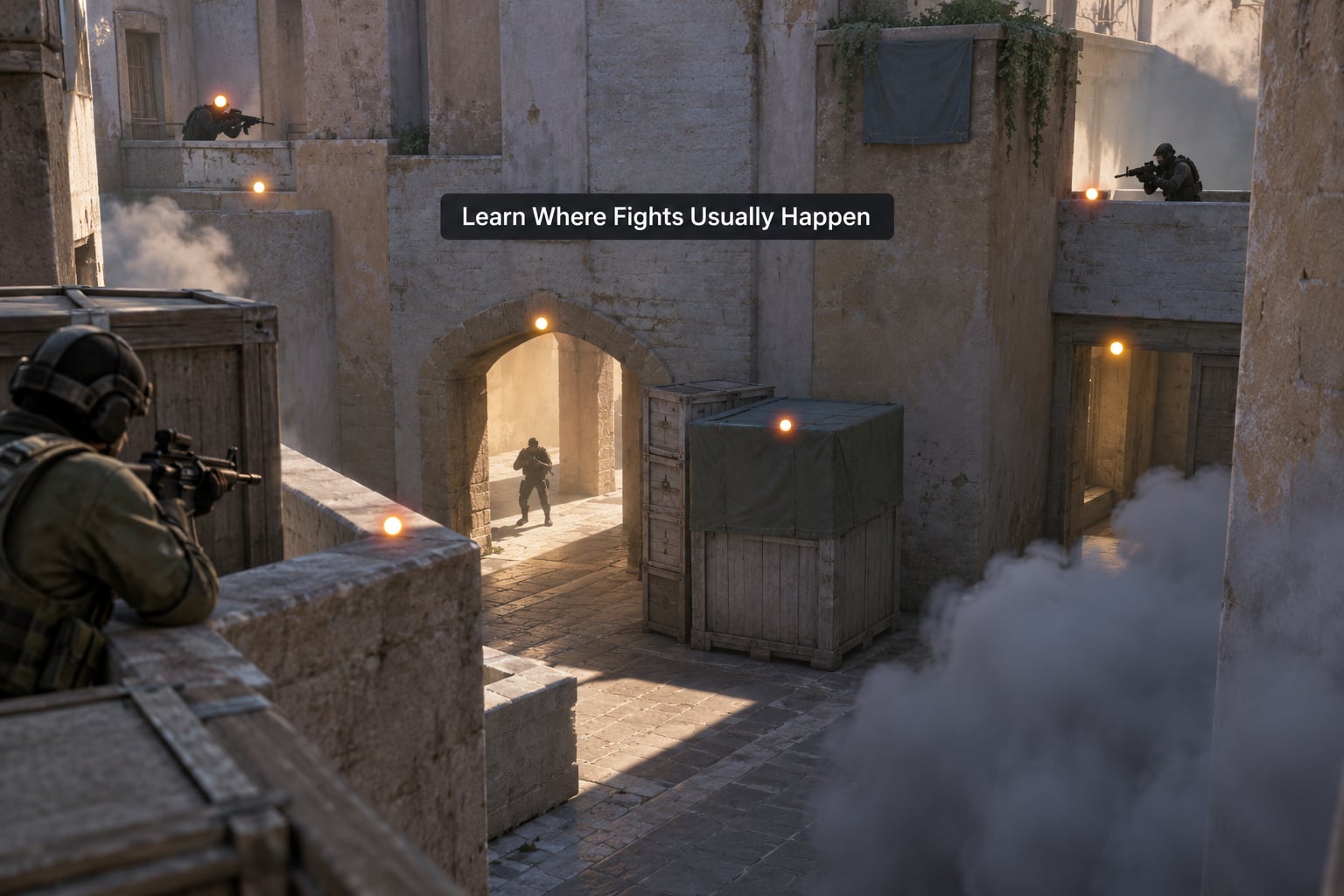
Ask two questions about every area: where do people actually meet, and which way do they come from? That second question is where map knowledge turns into an advantage, because knowing an opponent’s approach lane lets you hold your crosshair on the angle before it appears.
Pre-aim is the practical payoff here. Pick three common angles per map, hold them in your head as pictures, and rehearse them in the practice range. In tactical shooters these are usually the long corridor, the doorway onto site, and the window overlooking a lane. In MOBAs, it is river, the jungle choke and each tower’s back approach.
6. Test Your Memory Without Looking at the Map
Close the map. This is the step that separates learning from studying. From memory, draw the map on paper and name every position, then trace three routes: spawn to objective, objective to objective, and one retreat path.
Where you hesitate, you have found your gap. Fix that gap with another ten-minute walkthrough, not another ten minutes of image study.
| Session | When | Length | Focus |
|---|---|---|---|
| First walk | Day 0 | 20-30 min | Landmarks and routes, out loud, no combat pressure |
| Recall test | Day 1 | 10 min | Redraw the map from memory, name every callout |
| Second walk | Day 3 | 15 min | Fix gaps from Day 1, add angles and escape routes |
| Recall test | Day 7 | 10 min | Routes under a stopwatch, no map, in a custom game |
| Maintenance | Day 14 | 10 min | One full run, then live matches only |
This cadence is the actual answer to how to learn a new map fast. A short session on r/TrackMania described grinding five to ten maps for ten minutes each, every day, and reporting a real difference — short and frequent beats one long evening, every time.
7. Apply the Knowledge in a Real Match
Play one low-risk match first, calling your positions out loud. Then play normally and change nothing. After each match, spend two minutes answering one question: where did I get lost, and which callout would have fixed it?
Keep a rough time expectation so you know whether you are behind or fine. These are typical ranges, not promises:
| Genre | Usable | Competitive |
|---|---|---|
| Tactical shooter (CS2, Valorant, Siege) | 5-10 hours | 25-40 hours |
| MOBA (League, Dota, Age of Empires) | 10-15 hours | 40-60 hours |
| Battle royale (Fortnite, Warzone) | 8-12 hours | 30-50 hours |
| Extraction or survival | 15-20 hours | 60+ hours |
| Sandbox or custom maps | 2-5 hours | Varies entirely |
Anyone quoting much faster numbers is usually counting only the time spent looking at the map.
Common Mistakes
Memorising too many tiny details at once is the first one. Crate corners and decorative angles feel productive and teach almost nothing. Learn the landmarks and routes first, then add small positions only when they show up in real fights.
Ignoring spawn points is the second. Spawns decide where fights begin, so a player who knows every spawn usually beats an equally skilled player who does not. It is also the cheapest knowledge on any map — five dots on a page.
Practising only with the map open is the third, and it is the most common. If you hold TAB for every rotation, you never build recall, and you will still be lost when the map closes. Half your practice should happen with it closed.
Not reviewing is the fourth. Learning a route once, then not touching it for a week, means starting over every time. The Day 1 and Day 7 recall tests in the table above exist for that reason.
Studying on loss streaks is the fifth. After a bad run you are tired and tilted, and tired practice is nearly wasted. Study before the queue, not after the loss.
Learning every map in the pool equally is the sixth. If ranked is the goal, learn the maps you are actually queuing for. Once one is solid, move to the next. A player who knows three maps deeply beats a player who half-knows nine, and the depth transfers — the same categories of positions exist on every map.
One useful tracking habit: once a week, name every callout on your page from memory in under a minute. That is your progress metric. If the list is complete and fast, you have moved on. A new r/LearnCSGO reply described the same instinct from the other side, that learning one map until it is hardwired beats shallow coverage.
Frequently Asked Questions
How long does it take to learn a new map?
Roughly 5 to 10 hours gets most tactical shooter maps to a usable level, and 25 to 40 hours to competitive. MMOs and battle royales sit higher, usually 40 to 60 hours, because the map surface is larger. Extraction and survival games take the longest, since you cannot study the layout outside a raid. Judge progress by whether you can name positions without the map, not by hours alone.
Do I need to memorize every callout?
No. You need dependable ones. Every team uses a subset of names that come up in almost every round, and learning those deeply beats skimming the full list once. Pick the twelve to fifteen names that cover your team’s usual fights, use them consistently, and add more only when a round forces you to. Wrong-but-consistent naming costs far less than perfect naming you never use.
Should I learn one map at a time or rotate through the whole pool?
One map at a time, while ranked is your goal. Rotating through the pool spreads practice thin and leaves every map half-learned. Learn the map you queue for most until its routes and angles are automatic, then start the next. If you play a casual or mixed pool instead, light rotation works fine because you are practising format, not a single layout. Revisit the old map once a fortnight to keep it sharp.
How do I study while still playing ranked?
Study in short blocks before you queue, not instead of queueing. Ten minutes of walking routes with the map closed, then two normal matches, beats an hour of study followed by no matches at all. After each match, note one place you got lost and look up the callout for it. That post-match correction is where ranked turns into study time rather than just consumption.
What should I focus on in shooters versus MMOs?
In shooters, focus on spawn locations, common angles and pre-aim positions, because fights are short and information is the win condition. In MMOs, focus on routes, objectives and vision, because map knowledge shows up in rotation timing and vision control rather than duels. Strategy games sit in between: the structure of your opening buildings and the first expansion route matter more than any single angle.
How do I remember a map after a long break, or after a rework?
Treat both as a fresh map and restart at step one, but spend half the time on changes. After a break, the structure is still there and comes back in two or three sessions. After a rework, assume the old habits are actively hurting you, find what moved or was added, and re-walk every route you had memorised. Players returning after a break often report map knowledge as their weakest area for exactly this reason.
One last thing, since it comes up often: if you actually meant learning world or physical maps, the four methods are orientation, scale and distance, symbols and legend, and grid references. Start by orienting, then read scale before anything else.
Conclusion: What to Do First
Do this before your next match: learn the map’s six biggest landmarks, trace the five routes between them, then redraw the map from memory with the map closed. That single twenty-minute session is worth more than a weekend of looking at labelled images, and it is the fastest route to learning a new map fast.