A tutorial fails new players when it demonstrates what is easy to show instead of what is actually hard to learn, punishes experimentation, and then disappears at the exact moment the player needs a reference. The result is not a bored player, it is a lost one. In most MMOs and browser games the player has already left.
That is worth taking seriously because the opening minutes carry more weight than anything a studio ships afterwards. New players do not compare your combat system against other games, they compare it against the last five minutes they spent. If those five minutes felt confusing, hostile or pointless, the rest of the world never gets judged.
Below I break down the failure patterns that show up again and again in player threads, what they do to retention, and what changes them.
Table of Contents
- 1What Does It Mean When Tutorials Fail New Players?
- 2How tutorials fail new players in the first three minutes
- 3The Most Common Tutorial Failures in Browser and MMO Games
- 41. Teaching the easy stuff and skipping the hard part
- 52. Information overload and stacked pop-ups
- 63. Lock-room gating that strips away agency
- 74. Repetition drills before any real play
- 85. Fail states that punish experimentation
- 96. The skip paradox: essential content behind a skip button
- 107. The tutorial ends exactly when the game starts
- 118. Settings, accessibility and environment blockers
- 12How Can Designers Make New-Player Tutorials Easier to Follow?
- 13Which Signs Show That a Tutorial Is Causing Player Dropout?
- 14How Do You Fix a Tutorial Without Removing the Challenge?
- 15Separate required knowledge from optional mastery
- 16Cap the cost of a mistake in seconds
- 17Measure completion, not clicks
- 18Test it on someone who has never played the genre
- 19What Should Players Do When a Tutorial Is Unclear?
- 20Check whether something outside the game is blocking you
- 21Rebind anything that fights your setup
- 22Go back to the current objective, not the start
- 23Use the community reference, then say so
- 24Record the failure before you work around it
- 25Frequently Asked Questions
- 26How can I tell whether a tutorial is confusing new players or simply too difficult?
- 27Why do new players quit games in the first few minutes?
- 28Should an MMO tutorial explain every game system before players enter the world?
- 29What is the most important metric for measuring tutorial quality?
- 30Are visual tutorials better than written tutorials for new players?
- 31Is skipping a game tutorial a bad idea?
- 32Conclusion: Start With the First Three Minutes
What Does It Mean When Tutorials Fail New Players?
A tutorial has failed a new player when the player cannot state what they were asked to do, cannot complete the first action without outside help, learns that being wrong is expensive, or closes the game before reaching the moment the game was built to deliver.
It is tempting to treat this as a content problem, as if the tutorial is simply missing an explanation. It is not. Player research on browser and mobile games points somewhere less comfortable: most players say they dislike tutorials, and players who sit through a good one stay noticeably longer than players who skip it.
Read together, those two findings describe the paradox. Players do not hate being taught, they hate feeling stupid while being taught. A tutorial that keeps the player competent is welcome. A tutorial that keeps the player failing is resented, and it is also the reason they leave.
How tutorials fail new players in the first three minutes
Churn concentrates hard at the start. Drop-off inside the first few minutes of a first session runs far higher than at any point later in a game’s life, and a large share of it turns out to be recoverable when the underlying design changes rather than the tutorial text.
Three minutes is roughly long enough to create a character, move around and enter the first fight. It is not long enough to learn a skill tree, a crafting economy, a role system and a map. So the first three minutes have to do one job, and most tutorials try to do six.
| Failure mode | What the player experiences | Why it costs retention | What changes it |
|---|---|---|---|
| Teaching the easy stuff | Move, look, attack, done | The hard systems stay hidden until the first real fight | Teach the one mechanic players actually get wrong |
| Pop-up overload | Four prompts fire while a fifth is being read | Working memory empties, the player stops reading all of them | One prompt at a time, persistent until answered |
| Lock-room gating | Do this three times, then that three times | Player agency drops to zero, so nothing is retained | Teach inside a sandbox, then into live play |
| Punishing failure | A mistake costs several minutes of replay | Players stop experimenting, which is the one thing that teaches | Respawn in seconds, keep the mistake informative |
| Skippable but essential | Skip button everyone presses | Skippers hit an unexplained wall and quit; keepers resent it | Let skipping teach on demand instead |
| Tutorial ends, level begins | Everything changes at once | Transfer of learning fails, skills never transfer | Extend guided play into the first real mission |
| No persistent reference | Controls are gone after one screen | Players forget inputs within a single session | Keep a control list and a replayable archive |
| Environment blockers | Windowed mode, wrong sensitivity, colour-only cues | Progress is impossible and the player blames the game | Test on real hardware with default settings |
The Most Common Tutorial Failures in Browser and MMO Games
These eight patterns cover most of what players complain about when tutorials fail new players. Each one looks reasonable in a design document, which is exactly why they survive to launch.
1. Teaching the easy stuff and skipping the hard part
Most tutorials spend their time on movement, aiming and interacting, because those are easy to script and easy to show. What players remember needing is the difficult material: the ability rotation, the role system, the item builds, the economy.
Players on r/joinsquad described their game’s tutorial as covering the literal bare minimum, with movement, shooting and destroying a HAB and nothing on the roles that actually make the game hard. That sentence generalises further than it looks. Anything the player could have worked out alone is what gets taught, and everything that costs them a loss gets left out.
2. Information overload and stacked pop-ups
The failure is rarely one bad prompt. It is four prompts opening while a fifth is still being read, each one important, none of them dismissible without losing context.
Fighting game players on r/StreetFighter put it more sharply: the information exists but you cannot act on it while you are reading it. The tutorial teaches on one screen and asks you to perform on another, so the cognitive load lands all at once instead of being distributed across practice.
3. Lock-room gating that strips away agency
A closed room with a single exit and a required action removes every decision that normally makes a game feel like a game. Players end up performing rather than playing, and performance is far easier to forget.
Developers on r/IndieDev, in the thread that ranks first for this query, single out exactly this pattern: a tutorial that locks you in a room and makes you do one thing three times, then another thing three times, for every mechanic before you touch real gameplay. The repetition is the tell. If a player is performing a mechanic under supervision, they are not yet learning it.
4. Repetition drills before any real play
Repetition is not teaching, it is volume. Three successful repetitions of a required action proves the game can be completed, not that the player understands why the action exists.
Compounding this, the drill usually happens in a sterile space with no stakes and no opposition. Nothing about it resembles the situation the skill will be used in, which is precisely why it evaporates at the first real encounter.
5. Fail states that punish experimentation
The rule of thumb from player threads is consistent: a mistake during the tutorial should cost seconds. Every account of a tutorial that felt hostile involves losing minutes and restarting a sequence from the top.
That pattern shows up repeatedly on ResetEra, where players describe Far Cry forcing a stealth section during the tutorial and dropping them minutes back in time whenever the mechanic failed. The player learns the right lesson, which is that the game is not worth experimenting in.
6. The skip paradox: essential content behind a skip button
Nearly every modern game offers a skip. Almost all of them offer a skip on content that later turns out to be mandatory, which produces the same outcome from both directions.
Skippers arrive at the first unexplained wall and quit. Players who sit through it resent the moment they realise they had a choice. An r/DotA2 thread asking for tutorials to be made mandatory for new accounts exists because the free-skip route leaves people with a game they do not understand and something to blame.
The way out is not forcing the tutorial. It is making the skipped material available on demand, at the moment the player discovers they need it.
7. The tutorial ends exactly when the game starts
Transfer of learning is the quiet failure nobody logs. The player completes every objective correctly inside the guided section, then meets the same systems with enemy pressure, a party of strangers and a map they have never seen, and none of it holds.
This is the gap between a tutorial and the first level, and most of it is structural. The tutorial teaches isolated systems, then the level asks for them at once. A player can pass 100% of the tutorial and still be unable to play.
8. Settings, accessibility and environment blockers
Some tutorial failures are not design failures at all, they are environment mismatches. An r/Warframe thread describes a new player unable to finish the tutorial because the game launched in a windowed mode and the mouse sensitivity did not match their desktop setup.
The same category covers non-remappable inputs, cues signalled only by colour, and prompts placed where a controller user’s thumb rests. None of these look like onboarding problems in a design document, and all of them block progress completely.
How Can Designers Make New-Player Tutorials Easier to Follow?
The fix is not more text. It is better sequencing, fewer simultaneous demands, and a place where trying things cannot cost the player much.
- Teach one meaningful action at a time. A step is finished when the player performs it, not when they click through it.
- Connect every task to an immediate outcome. If the action produces nothing visible, the player never learns that it was the point.
- Use progressive disclosure. Introduce the advanced system in the context where it becomes necessary, not in the first ten minutes.
- Give reinforcement in two forms. A demonstration covers movement and targeting, while short text carries recall and reference.
- Provide a safe practice space that persists. A sandbox the player can return to is more valuable than a sandbox they are pushed through once.
- Escalate hints instead of repeating prompts. A reminder, then a highlight, then a demonstration, then a takeover. Repeating the same prompt teaches nothing.
There is also a version of this that uses no pop-ups at all. Design the level so the only sensible path teaches the mechanic: a locked door teaches opening doors, a hazard on the floor teaches jumping, an enemy that cannot be beaten teaches the attack. Players on game design forums describe this as the silent teacher, and it is the approach most likely to survive contact with a player who will not read anything.
Which Signs Show That a Tutorial Is Causing Player Dropout?
Player loss in the opening minutes has several possible causes, and the difference matters because each one needs a different fix. A spike at character creation is an interest problem. A cliff at the end of the tutorial is a transfer problem. A flat line where the difficulty should climb is usually a repetition problem.
- Exits during registration or character creation. Nobody has invested enough to leave over a tutorial, so this is about expectations set before play.
- A hard drop around the three-minute mark. The first fight or first objective is where teaching ends and the game begins. This is the classic transfer gap.
- Progress that stalls and never resumes. Players hit a blocker, a settings problem or an unskippable failure, and the session ends rather than the attempt.
- Help requests that ignore the current objective. Questions about basic controls, menus and where to go are a sign the interface is not self-explanatory.
- Repeated deaths with no recovery guidance. Players are not learning from failure because the game gives them nothing to read after it.
- A high skip rate paired with a high quit rate shortly after. The skip is not the problem, but skipping into an unexplained world is where the problem becomes visible.
- Community threads asking for a tutorial that should already exist. A wiki thread or a video request is the clearest signal available, because someone already did the work of telling you what failed.
Session replays are the most honest source here. Watch a handful of first-time players without commenting and the moment where the player stops moving is usually obvious long before anyone reports it.
How Do You Fix a Tutorial Without Removing the Challenge?
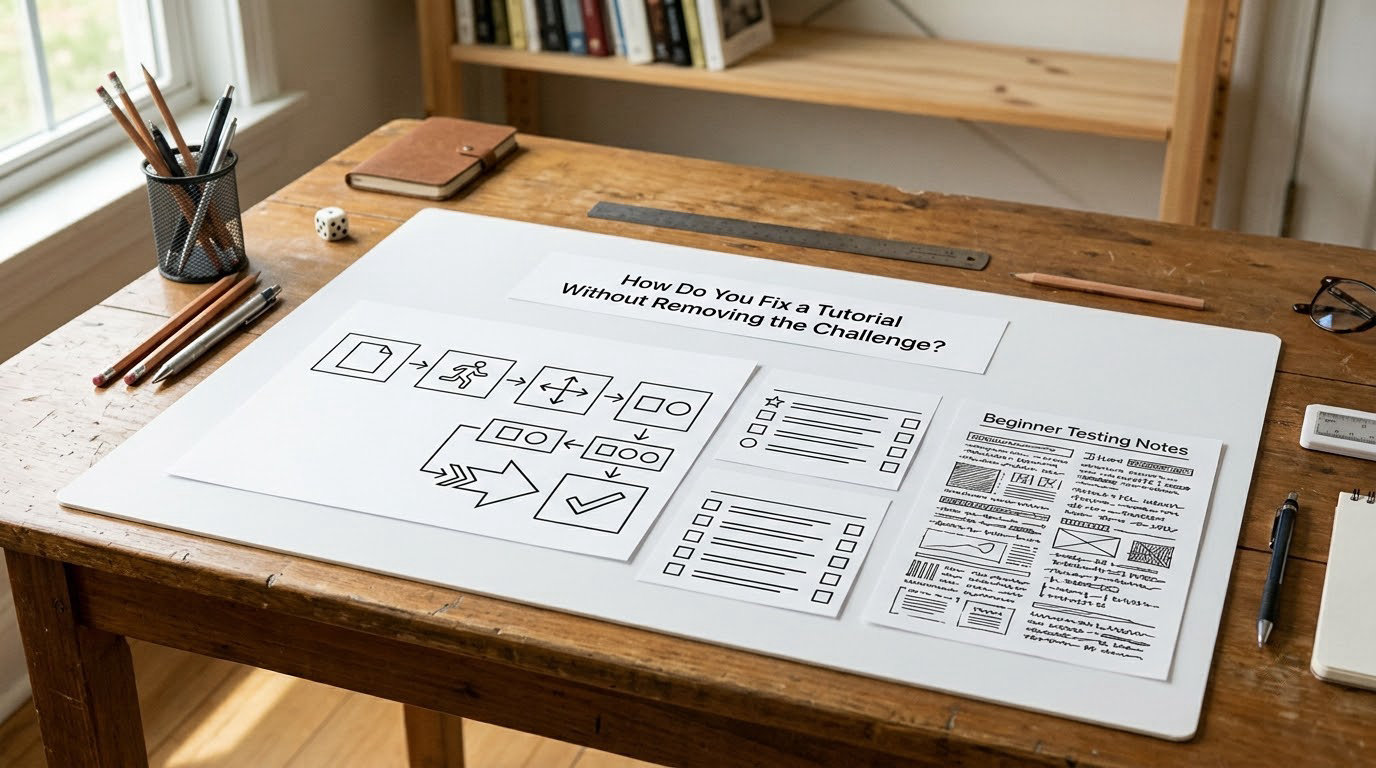
Difficulty and confusion are different problems, and confusion is the one worth removing first. A player who dies because they made a good decision is having a hard time. A player who dies because they never saw the input is not.
Separate required knowledge from optional mastery
Decide which mechanics a player cannot complete the first mission without, and cut everything else from the required set. Advanced builds, optimisation paths and rare drops can all wait. Keeping the requirement list short is what makes the tutorial finishable in one sitting, and a tutorial that finishes is one players stay for.
Cap the cost of a mistake in seconds
Checkpoints should sit close enough together that a failure costs a handful of seconds. When a mistake costs minutes, experimentation stops, and experimentation is how players learn the rest of the game without you.
Measure completion, not clicks
A click-through rate on a tutorial prompt tells you the prompt was visible and not that anything was learned. The metrics worth watching are whether players complete the first objective, reach the first meaningful combat or social milestone, and return for a second session.
Test it on someone who has never played the genre
Internal playtests recruit people who already know what a quest marker is. Test with players from outside the genre, watch them without helping, and note the first moment they hesitate. That hesitation is the tutorial’s next fix.
What Should Players Do When a Tutorial Is Unclear?
None of this is the player’s fault, and it is worth saying plainly. A game that cannot be played from its own guidance has a problem, and the useful response is a recovery path plus an honest report.
Check whether something outside the game is blocking you
Before blaming the tutorial, rule out the environment. Confirm the display mode, the pointer speed, the control bindings and the audio output match what you use outside the game. Windowed mode, a sensitivity that was never set and inputs your keyboard does not have are all common causes of a tutorial that appears completely stuck.
Rebind anything that fights your setup
If the defaults are uncomfortable, change them and continue. Learning a game on bindings you dislike teaches the bindings, not the game, and players who remap tend to stick with a title longer.
Go back to the current objective, not the start
Most MMOs keep a quest log. Read the active objective, find it on the map and complete only that. Restarting from the beginning because one step is unclear is the single biggest time sink in this genre, and skipping forward risks landing in later content that assumes the step you missed.
Use the community reference, then say so
Wikis, class guides and video walkthroughs exist because the in-game guidance left gaps, and players on r/Frostpunk are blunt that requiring outside research is a design failure. Use them, but report the gap in the game’s own channels. The report that gets fixed is the one that names the exact moment, the exact prompt, the exact input, and what you expected to happen instead.
Record the failure before you work around it
If you solved it yourself, that solution is the missing tutorial. A short clip or a two-line description of what confused you is more useful to a developer than a bug report saying the tutorial is unclear, and it costs you about a minute.
Frequently Asked Questions
How can I tell whether a tutorial is confusing new players or simply too difficult?
Watch a first-time player rather than reading the design document. Confusing tutorials produce skipped prompts, repeated navigation errors, ignored objectives and questions about basic controls. Genuine difficulty produces steady attempts, clear cause and effect, and players who return after dying. If the player is lost, it is confusion. If the player is losing and adjusting, it is difficulty.
Why do new players quit games in the first few minutes?
Most players decide within the first three minutes, usually before the first real fight. The reasons are consistent: too many prompts at once, a mechanic that was demonstrated but never practised, a failure that costs too much time, or an objective that was never stated clearly. The opening cannot afford to teach six systems at a low-stakes moment when it only has room for one.
Should an MMO tutorial explain every game system before players enter the world?
No. A beginner tutorial should teach only what the first meaningful experience requires, then introduce advanced systems contextually. Explaining combat, crafting, the economy, guilds, mounts and every class at the start exceeds what a new player can hold, and the parts they skip are the parts they will not remember.
What is the most important metric for measuring tutorial quality?
Completion alone is not enough. Track the share of new players who finish the first objective, reach the first meaningful combat or social milestone, and return for a second session. Click-through on a prompt only proves the prompt was seen. Sessions that continue past the tutorial are the number that moves with tutorial quality.
Are visual tutorials better than written tutorials for new players?
Neither works on its own. Visual demonstrations carry movement, targeting, menus and interface states far better than text can. Short written reference supports recall, is searchable, and can be reopened later. The strongest approach pairs a demonstration with a persistent written list, rather than asking players to remember a video they watched once.
Is skipping a game tutorial a bad idea?
Skipping rarely causes a problem by itself. The risk is that you arrive at content which assumed the skipped material, meet a wall you cannot interpret, and conclude the game is badly made. The better test is whether the game still teaches the system when you need it. If it does, skipping is fine. If the tutorial was the only explanation that existed, skipping costs you.
Conclusion: Start With the First Three Minutes
The pattern across every complaint here is the same: tutorials teach what is easy to demonstrate instead of what is actually hard to learn, then punish the player for figuring it out. Fix that and most of the rest takes care of itself.
If you are building a game, watch one first-time player today and note the exact second they hesitate. If you are playing one, check your settings before you blame the tutorial, and report the moment it broke rather than the game in general.