If you want to know how to organize an in house scrim night, the short version is this: pick a format, lock the roster, write down the rules, and run a timed schedule with a debrief at the end. A scrim night is a scheduled block of practice matches your group plays against another roster, usually a second team from your own group or community, so you can test strategies, practise comms, and build chemistry without any ranking on the line. Organizing one is mostly paperwork before the first lobby opens. Budget two to four hours, and expect the planning to take about an hour the week before.
This guide works whether you are five friends on a couch, a collegiate program with a practice room, or two rosters sharing a gaming house. The steps are the same online or at a table, and the only real differences are network setup and whether someone handles the lobby.
If your night is less competitive and more social, the same structure still holds. Just loosen the rules in Step 3 and shorten the matches.
Table of Contents
- 1What You Need
- 2People and roles
- 3A rules document everyone reads
- 4Game settings and version
- 5Hardware and network
- 6Comms and recording
- 7Score sheet
- 8Step-by-Step
- 91. Define the in house scrim night format
- 102. Pick the date, venue, and player roster
- 113. Create the rules and match-day checklist
- 124. Build the schedule, map rotation, and scoring system
- 135. Test the lobby, connection, and game settings
- 146. Hold check-in and the pre-scrim briefing
- 157. Run the matches and close with a debrief
- 16Common Mistakes
- 17Frequently Asked Questions
- 18How long should an in house scrim night be?
- 19How many players do I need for a fun scrim night?
- 20Should I use maps, modes, or stages?
- 21How do I keep teams fair when players have different skill levels?
- 22Can I run an in house scrim night entirely online?
- 23How should I handle late arrivals, disconnects, and disputes?
- 24Conclusion
What You Need
Six things have to exist before anyone logs in: a roster with roles, a one-page rules document, the exact game settings, the hardware and network, the comms and recording stack, and a place to track scores.
People and roles
You need one person per team slot, one substitute per team, and one person who is not playing. That third role is what most in house nights are missing, and its absence is why scores get disputed and recordings never get made. On a small group, the scrim leader can be a player, but they should not also be the shot-caller during the match.
- Scrim leader: owns the schedule, the timer, and the results sheet.
- Shot-caller: one person per team who calls the plan out loud. One voice, not three.
- Recorder: runs the capture on every machine so you have footage to review later.
- Substitutes: at least one per team, ready with accounts loaded and headset tested.
A rules document everyone reads
One page, posted in your group channel a few days ahead. It covers eligibility, team formation, bans, pauses, comms etiquette, and what makes a result valid. If a rule is not written down, it gets argued about at 11pm.
Game settings and version
Write down the game mode, map pool, match length, server region, and the patch or client version everyone is on. A version mismatch is the most common cause of a lobby that looks completely different from what you rehearsed. Name the title in your docs too, since the format translates to Valorant, Counter-Strike 2, League of Legends, Rocket League, and most other team titles, but the specific mode names differ.
Hardware and network
Every machine runs the same settings, the same resolution, and has a wired connection where possible. For an offline LAN night at a house or studio, check that your router handles the full group on one network, that power strips are not chained, and that chairs and screens are set up before anyone arrives. Heat is the quiet killer of a long offline session.
Comms and recording
A voice channel per team inside your usual call app, plus one admin channel for the scrim leader. A screen recorder per machine, using OBS Studio or NVIDIA Shadowplay depending on hardware. Store the files in one shared folder with a naming pattern like date, teams, map, so review is not a scavenger hunt.
Score sheet
A shared spreadsheet is enough. One row per map, columns for the result, the rounds played, and notes. Back it up with the recording links in a second tab.
Step-by-Step
Here is the sequence that gets you from an idea to a debrief, in the order that saves the most rework.
1. Define the in house scrim night format
Decide what the night is for before you decide when it is. Practice that has no objective turns into four hours of playing and nothing to review, which is the most common complaint from teams who scrim a lot and improve slowly.
Write down these seven things:
- The objective: test a new composition, practise comms, build map pool depth, or just get reps.
- The expected skill level, so nobody walks into a blowout.
- Team size and whether you play one game mode or two.
- Match length and number of matches, based on the table below.
- Whether the night is casual or competitive, and whether ranking or prize is on the line.
- Which map or stage pool, and who has veto rights.
- What gets recorded and reviewed afterwards.
Pick the match format by how much time you actually have, not by ambition.
| Format | Best for | Typical length | Watch for |
|---|---|---|---|
| Best of 1 | Fast reps, large groups, rookie tryouts | 20 to 30 minutes | Too few rounds to judge anything beyond openings |
| Best of 3 | The default for a weekly night | 60 to 90 minutes with breaks | Losing early and skipping map two to save time |
| Best of 5 | Qualifier prep or a full team test | 2 to 3 hours | Fatigue skewing the last map |
2. Pick the date, venue, and player roster
Block a recurring slot on a shared calendar rather than a one-off invite. A fixed weekday and time builds the habit, and the habit is what keeps a team from drifting apart.
Put the time zone and the local start time in the invite, spelled out. The most common message in any scrim group is still someone asking what time it actually starts, and that confusion kills more sessions than bad connection.
For the roster, count up honestly. A five slot game with seven players interested is the standard case in amateur groups, and the fix is a rotation policy, not a coin flip. Split the session into two blocks, put one substitute in each block, and swap them after the first two maps so both get real reps. Write the rotation into the rules doc so nobody feels like the schedule favors starters.
Set an attendance deadline two days out and a substitution deadline the day of. Once the block starts, roster changes stop unless the scrim leader calls them.
3. Create the rules and match-day checklist
This is where an in house scrim night either becomes organized or becomes noise. The rules doc needs a dozen lines, and every line prevents a specific argument.
Cover these items:
- Eligibility: who is on the roster tonight and who counts for the result.
- Team formation: how teams are made, who seeds them, and when reseeding happens.
- Bans and veto: who picks first, how long the veto window lasts, what happens if it runs over.
- Pauses: when a pause is allowed, how long the clock stops, and who calls it.
- Comms etiquette: one caller per team, no cross-team talk in the voice channel, no trash talk after a round.
- Interruptions: phone calls, doorbells, noise. A common house rule is that anyone can call an interruption pause once per map.
- Disputes: who arbitrates, how a claim is filed, and when a result is final.
- Valid result: both teams full, no player on two rosters, no alternate accounts with a rating advantage. Handicapping your way into a lower bracket, or bringing stacked accounts, breaks trust with the other group fast and it is the reason small communities end up quietly avoiding certain teams.
Put the checklist on one printable page with tick boxes. If a note can go in a pocket, it should.
A simple remote house rules template looks like this:
Server: closest common region. Map pool: five maps, each team vetoes one, hosts pick first. Pause: two per map, two minutes, caller only. Dispute: raise it in the admin channel within two minutes of the round, the scrim leader rules immediately and it is final. Substitute: only between maps, and only if both teams swap in the same window.
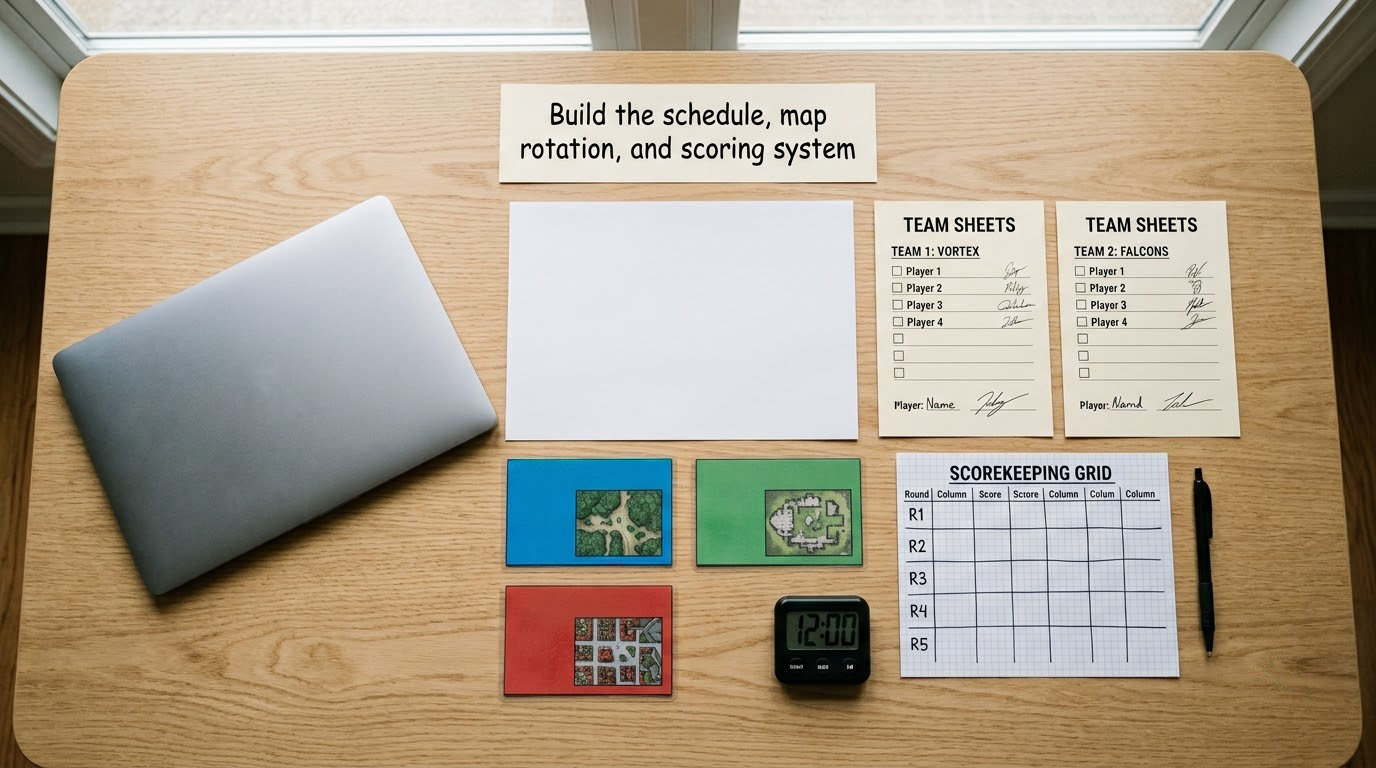
4. Build the schedule, map rotation, and scoring system
Write the timeline before you invite anyone, then paste it into the invite. A run of show removes about half the mid-session friction, because nobody has to guess when the next match starts.
| Time | Block | What happens |
|---|---|---|
| 0:00 to 0:15 | Warm-up | Aim routine and a short scrim map, both teams together |
| 0:15 to 0:20 | Map veto and draft | Vetoes, side pick, composition lock |
| 0:20 to 1:05 | Match 1 | Timed, recorded, one caller per team |
| 1:05 to 1:15 | Break | Stand up, drink something, no debrief yet |
| 1:15 to 2:00 | Match 2 | Same rules, swapped side pick if tied |
| 2:00 to 2:10 | Break | Optional short third map if both teams want it |
| 2:10 to 2:20 | Debrief | Three things that worked, three to change, no blame |
Keep the whole session at two hours for most nights. If you want three nights a week, two-hour blocks beat one four-hour marathon because reps spread across days compound better and nobody plays fatigued.
For the map rotation, put every map in the pool in play before any map repeats. If the pool is larger than the number of maps you will play, ban unused maps at the veto instead. Track the order in the score sheet so nobody argues about what map three was.
For scoring, separate the match result from any ranking system. The match result is the scoreboard: rounds per map, and the series winner. Any standings or points system should be a separate sheet with a written formula, applied after the night is over and never mid-series. Blowing up a map two lead because of a standings dispute is the fastest way to make people stop showing up.
5. Test the lobby, connection, and game settings
Run the whole setup 30 minutes before start time. Not the day before. The failure you will hit is always the one that appears at 8:02pm when five people are already in a call.
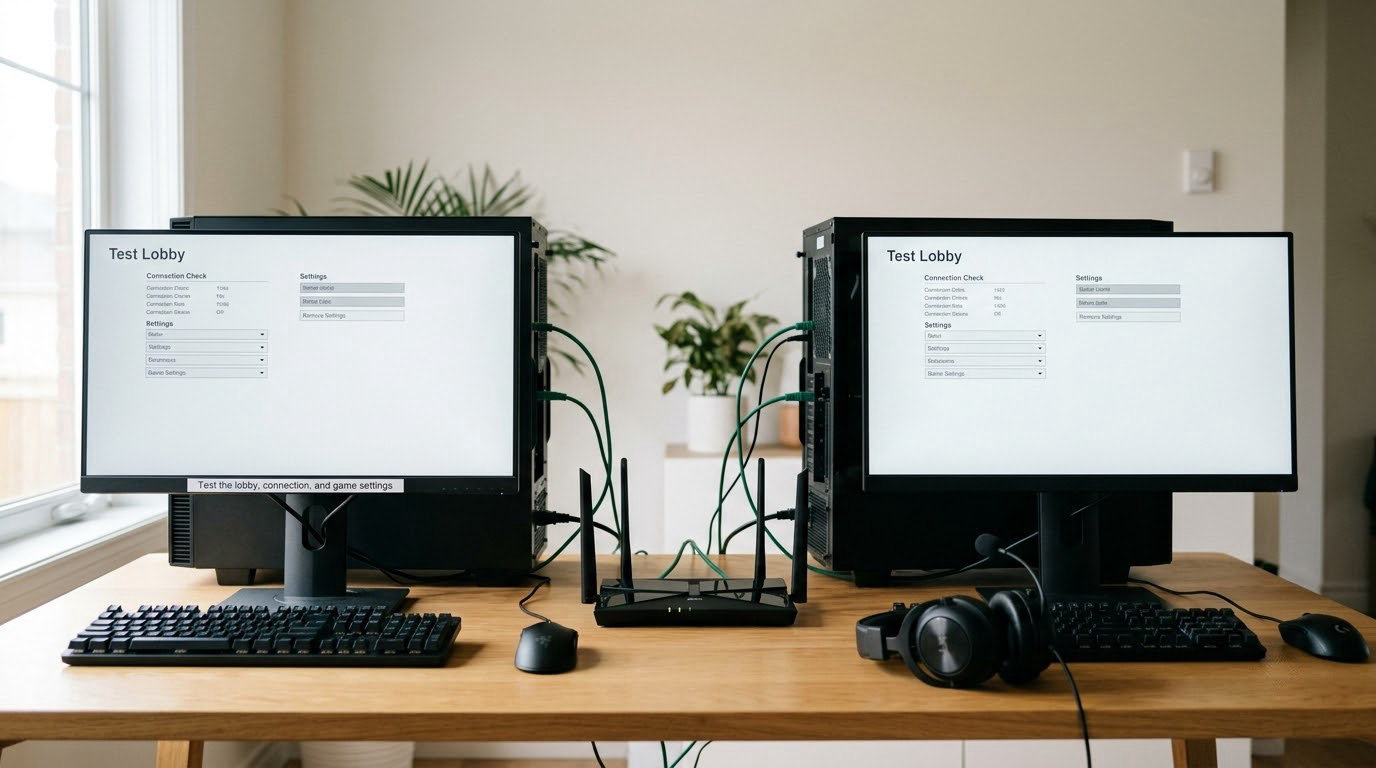
Check each item:
- Game version matches on every machine.
- Lobby permissions: invite-only, correct spectator setting, admin rights for the scrim leader.
- Voice channels work and each team has its own.
- Network stability: run the built-in connection or ping test on every machine and note the number.
- Recording is actually capturing, tested on one machine with the others watching the preview.
- Score sheet is open and shared to the right people.
- Substitutes have accounts loaded and headsets working, so a swap takes under a minute.
Write the ping numbers down next to each name. When someone claims the connection was fine later, you have the data instead of a memory.
6. Hold check-in and the pre-scrim briefing
Check-in runs from 0:00 to 0:15 of the schedule and does four things: confirm who is actually present, hand out or confirm teams, check microphones, and answer the last questions. Do it standing up in the call. People talk more freely in the first ten minutes before the pressure starts, so ask what each team wants to test tonight and repeat it back.
Keep the briefing under five minutes and cover the same four points every time: the objective for tonight, the veto order, the pause and dispute rules, and who is recording. Repetition is the point. A briefing that changes shape each week gets ignored.
Watch for the two classic problems here. First, players who join but do not answer during check-in, because something else was going on at home. Second, a player who goes quiet right when the plan depends on them, which is usually the sign they have already decided they are playing badly.
7. Run the matches and close with a debrief
Administration during the match should be boring. The scrim leader keeps the clock, announces each block start, and stops the argument that is not going anywhere. If a dispute comes up, apply the rule you wrote in Step 3 and say the decision once.
Problems during the match escalate in order: first the player flags it to their own caller, then to the scrim leader in the admin channel, then the map pauses. Most teams skip straight to the last one and burn a pause on something that was a settings misunderstanding.
Confirm the result out loud after each map, write it into the sheet immediately, and link the recording. Results confirmed live, or not at all.
Then run the debrief. Ten minutes, blame-free, diagnostic. Ask each team two questions: what decision in the match cost you the most, and what should we change next time. Close with a written list of three changes, and read it aloud before anyone closes the lobby.
The following week, run a proper VOD review session, separately, within 48 hours. Pull two rounds per map, watch each one through to the end before pausing, find the decision point, then rewatch it with feedback specific to each role. The four mistakes to avoid are reviewing every round, blaming mechanics instead of decisions, reviewing only losses, and taking no notes.
Common Mistakes
Most failed in house nights come down to one of ten things, and each has a direct fix.
- Undersized roster with no rotation. Seven players, five slots, and the substitutes never play. Fix: split into two blocks and swap substitutes between them, in writing.
- Scoring nobody agrees on. Fix: score the match on the scoreboard, keep standings in a separate sheet with a written formula.
- The same three maps every night. Fix: play through the full pool before any map repeats, then ban the remainder.
- Untested connections. Fix: ping test on every machine 30 minutes before, numbers written down.
- Unbalanced teams. Fix: seed by role and rough skill, then reseed if the gap shows in the first two maps.
- No warm-up. Fix: 15 minutes of aim work and a scrim map, both teams together, before the veto.
- Late arrivals. Fix: a hard start time. Late players sub into the next block, they do not join mid-map.
- Ignoring a dispute. Fix: a 2-minute claim window and one ruling from the scrim leader. Settle it in the admin channel, not in the voice channel everyone is listening to.
- Ending without a debrief. Fix: 10 minutes, three changes written down, read aloud before anyone leaves.
- Too many nights. Fix: two or three nights a week with a rest week after every three. Burnout is real in amateur groups, and the fix is removing sessions, not adding them.
One more worth naming: ghost-posting, where a team commits to a scrim and then disappears without a word. If that happens to you once, ask privately. If it happens twice, stop inviting them. Reliability matters more to this community than any single result.
Frequently Asked Questions
How long should an in house scrim night be?
Two hours is the sweet spot for most groups. That gives you a 15-minute warm-up, a 5-minute veto, two 40 to 45-minute matches, two short breaks, and a 10-minute debrief. Longer sessions feel productive but play quality drops after about two and a half hours. If you only have one block, cut the second match rather than the debrief.
How many players do I need for a fun scrim night?
Count one more than the game needs per team, so a five-slot game wants six a side. That gives you one substitute per team and covers a late drop. With only one substitute, any single no-show cancels a match. A ten-person night feels more relaxed, a twelve to fourteen person night feels more competitive.
Should I use maps, modes, or stages?
Use the map or stage pool for the mode you actually play in ranked, not a special mode. Special modes change rotations and timings, so what you rehearse does not transfer. Set the full pool before the night and veto unused maps at the start. Play through every map once before any map repeats, then ban the rest.
How do I keep teams fair when players have different skill levels?
Seed by role first and rough skill second, then let the schedule correct itself. Play a short first block to see the gap, and reseed between blocks if it is wide. Avoid stacked or alternate accounts, because a win that was bought breaks trust with the other group permanently. Honest matching is what makes people accept a loss.
Can I run an in house scrim night entirely online?
Yes, and most groups start there. Use one voice channel per team plus an admin channel, invite-only lobbies with a recognizable host name, and the closest common server region. Test the lobby 30 minutes early with substitutes already in it. The only real difference from an offline night is that lobby hosting and recording become a named job.
How should I handle late arrivals, disconnects, and disputes?
Set the start time and hold it. Late players sub into the next block rather than joining mid-map. For disconnects, play the round out and resume from the pause rules you wrote down. For disputes, allow a 2-minute claim window after the round, then rule once in the admin channel and treat it as final.
Conclusion
Start with three things this week. First, write down the format, including the objective, the match length, and the map pool, so the night has something to answer. Second, confirm the players and the venue, with one substitute per team and a time written in the local zone. Third, run the whole match-day checklist 30 minutes before start, lobby, voice, recording, score sheet.
Everything else on this page is an improvement on those three. Once the basics stop being the problem, the night gets better on its own, and so does the group showing up to it.