Seasonal content keeps games alive because it turns a game you finished into one that always has a next goal. Recurring updates on a fixed calendar, from battle passes to holiday events to a full reset of your progress, give returning players a fresh start and lapsed players a reason to reinstall, which is why seasonal content keeps games alive long after launch week.
I have watched the same live-service game go from a launch-day spike to a quiet, dependable population over years, and the difference is almost never a sequel. It is a calendar.
Table of Contents
- 1What Does Seasonal Content Do for Player Retention?
- 2Why Seasonal Content Keeps Games Alive
- 3How the Seasonal Content Retention Loop Works
- 4What Makes a Seasonal Update Worth Returning For?
- 5How Often Should a Game Release Seasonal Content?
- 6How Does Seasonal Content Build a Community?
- 7Why Can Too Many Seasonal Events Make a Game Feel Tired?
- 8How Can Players Benefit from Seasonal Content?
- 9Frequently Asked Questions
- 10How long should a seasonal event last?
- 11What happens if I miss a seasonal event?
- 12Is seasonal content always pay-to-win?
- 13Should seasonal progress become permanent progress?
- 14How is seasonal content different from a permanent update?
- 15Why do games release seasonal events more frequently?
- 16What to Do First
What Does Seasonal Content Do for Player Retention?
Seasonal content is recurring, time-limited in-game content released on a fixed cadence. That includes holiday events, battle passes, limited-time modes, seasonal story arcs, anniversary celebrations and, in some games, a complete reset of player progression.
What it does to a player is change the routine. Goals move, the reward table changes, maps get reskinned for a festival, the ranked ladder resets, a storyline reaches its finale. You are playing the same game, but the questions you are answering are different this month than they were last month.
Retention is the side effect. Nobody stays because of a single event. They stay because the calendar keeps offering a reason, and because that reason keeps changing shape before it gets boring.
Why Seasonal Content Keeps Games Alive
Four things happen when a studio commits to a seasonal calendar, and all four have to be present for the model to hold up:
- It reopens the door for lapsed players. A new season is the one moment a returning player is not hopelessly behind, which is exactly the player who had already written the game off.
- It is far cheaper than new content. A six-week event reuses maps, enemies and systems that already exist. An expansion has to be built from new assets, new story, new balancing.
- It creates a predictable schedule. Players, guilds and streamers can plan around known dates, and the studio can plan revenue and server load around them too.
- It gives a community something to do together. Shared deadlines and shared rewards produce the conversations and the group nights that keep a game socially alive.
That last point is the one studios underrate. Players on r/DestinyTheGame have talked about seasonal events as what keeps the games feeling alive without the developer having to constantly build new things, and the same thread notes it takes pressure off players too, because not every seasonal reward is the only copy of that reward.
How the Seasonal Content Retention Loop Works
The loop is not complicated. It repeats on a fixed cadence, and each stage hands the player a reason to enter the next one.
| Stage | What the player experiences | What the game has to provide |
|---|---|---|
| Announce | A date, a teaser, a trailer | Lead time long enough to plan around, and a clear list of what changes |
| Participate | New objectives in the first week | Something that plays differently from last season, not just higher numbers |
| Progress | A visible track, a ladder, a reward tier | Milestones you can see yourself moving toward |
| Share | Screenshots, clips, a group night | Moments worth posting and reasons to play at the same time as friends |
| Return | The next date on the calendar | A predictable gap, not a surprise one |
Break any link and the loop leaks. Events with no shared moments produce nothing to talk about. Rewards with no visible track produce nothing to come back to. Announcements that land a day before launch produce nothing to plan around.
What Makes a Seasonal Update Worth Returning For?
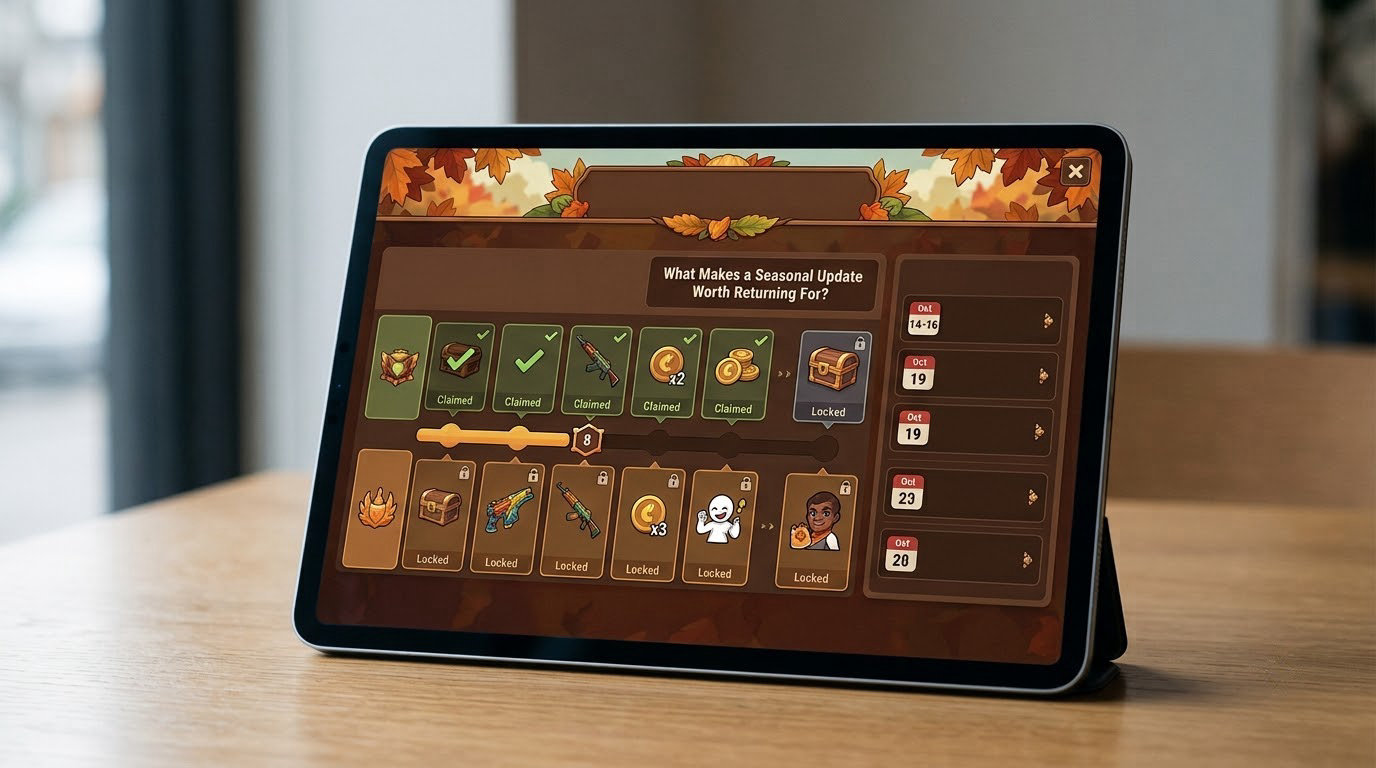
The useful version of a season changes more than the wallpaper. Here is what tends to hold up, and what tends to feel like padding.
- Rewards that are worth the hour. Cosmetic sets, emotes and stamps are fine when they are optional and generous. They stop working when the strongest option is locked behind the paid tier.
- Temporary goals. A short, self-contained objective you can finish in a week gives a player who has maxed everything else a reason to log in.
- Challenges with real variation. Different modes, different rules, different maps. If the objective is the same with a new name on it, players notice within a day.
- Cooperative activities. Group raids, community milestones and shared event goals are what convert a season into a calendar entry on four people’s phones.
- Visible progression. A battle pass track, a seasonal ranking, a community counter. Progress you can watch is progress people keep chasing.
Busywork is the opposite: dailies that repeat for fourteen weeks, chores that exist only to fill a number, a season that changes the reward skins but not the five minutes of actual play. That version runs out of goodwill fast.
One of the most-wanted pieces of information from players is simply what carries over and what resets, and studios are often vague about it. Clarity is part of the reward.
How Often Should a Game Release Seasonal Content?
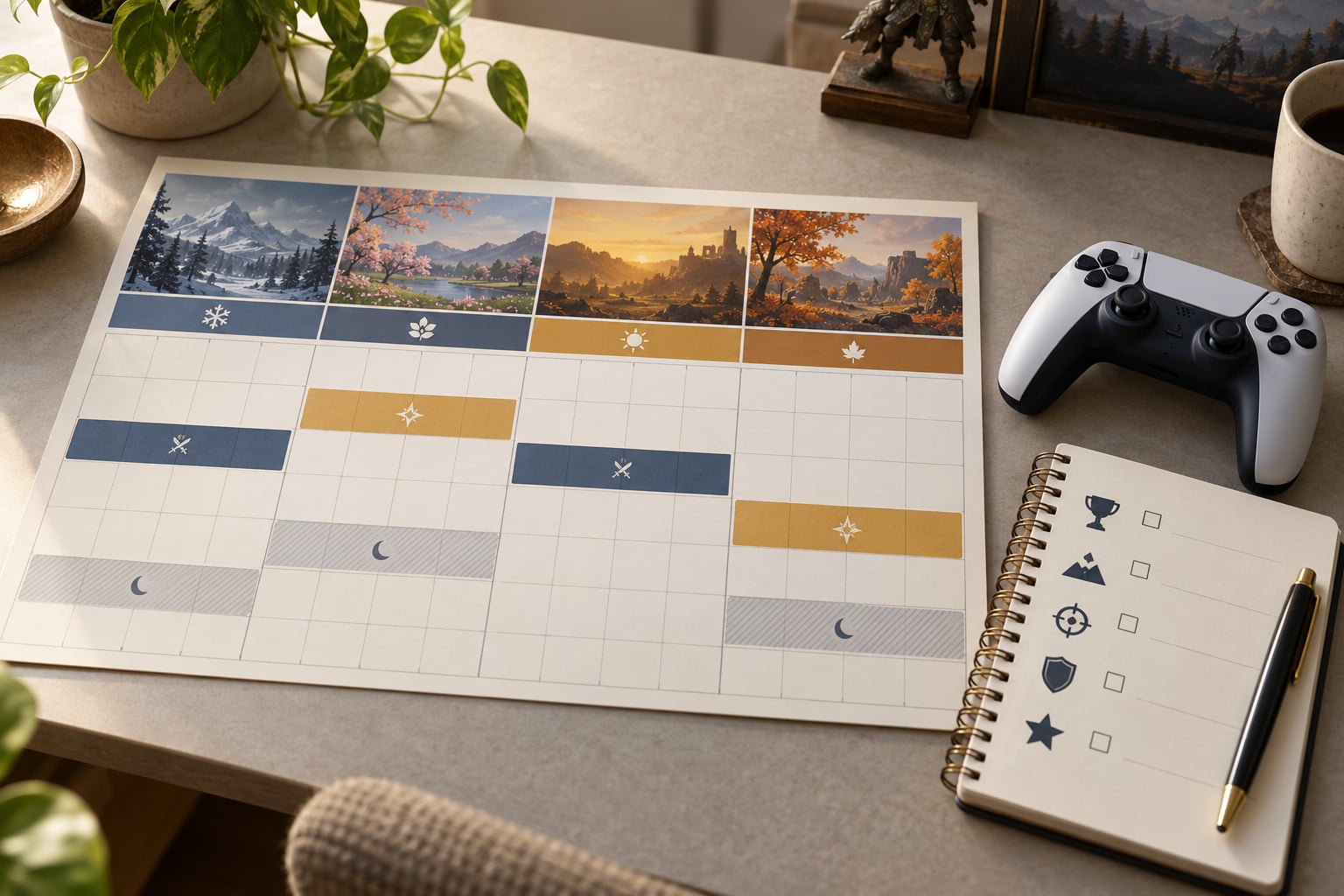
There is no correct interval. Duration should follow what players expect from that particular game and genre, not a schedule copied from another title.
| Cadence | Typical length | Suits | Planning horizon | Pacing players feel |
|---|---|---|---|---|
| Short | A few days to a week | Weekly challenges, holiday events, rotating game modes | Days | Busy and light, easy to dip in and out of |
| Medium | Around 6 to 10 weeks | Battle passes, ranked seasons, seasonal story arcs | A couple of months | A run you can finish, with a clear finish line |
| Long | A quarter or a full year | Expansion-flavoured seasons, annual events, themed chapters | Six months or more | Slow, story-driven, more committed |
Most games run a mix, and the mix is healthier than any single rhythm. A short event every week plus one medium season per quarter gives regular texture underneath one real story.
Frequency has been climbing across the industry, and the reason is not purely creative. A live-service title only earns its ongoing operating cost if players keep returning, so more seasons means more chances to bring back someone who drifted. The obvious cost is fatigue, which we get to later.
How Does Seasonal Content Build a Community?
Seasons work socially because they impose a deadline that everyone shares. A personal to-do list does not; a date does.
Leaderboards give guilds and fireteams a reason to practise on the same evening. Team objectives give scattered players a reason to accept a stranger’s invite. Community event days turn a developer’s schedule into a fixture that groups plan their week around, the same way a sports fixture does.
Annual events do something slightly different. They carry memory. An anniversary event is less about new mechanics than about the shared history of everyone who played through the earlier years, and that nostalgia is worth more to a community than another identical challenge ladder.
The thread on MassivelyOP’s Daily Grind column frames the honest version of this question: how many seasons can one person play before boredom sets in, and is that a flaw in seasons or in the player. Both answers are true, and it is worth sitting with.
Why Can Too Many Seasonal Events Make a Game Feel Tired?
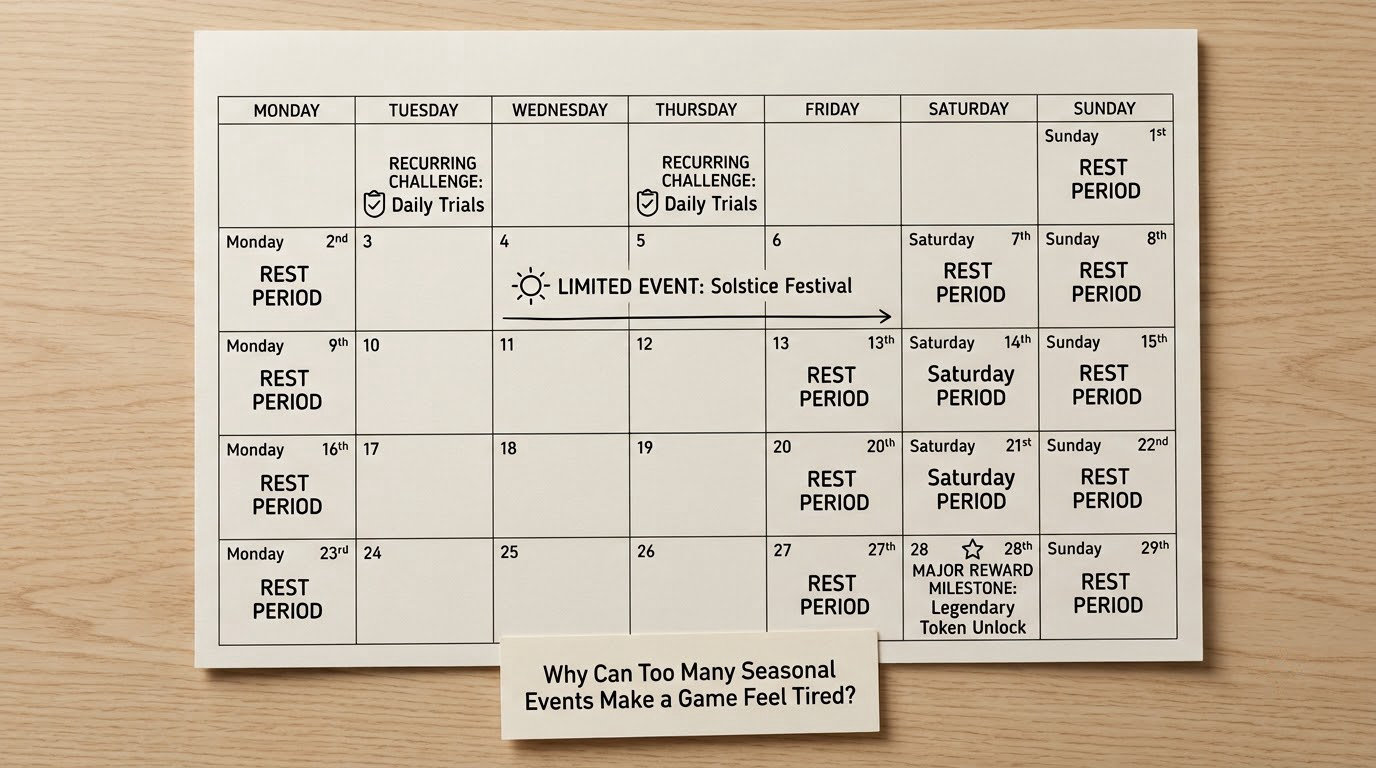
Content fatigue is real, and it has a recognisable shape. Players stop being surprised by a season and start treating it as a chore with a deadline attached.
The usual causes:
- Repetitive objectives. The same structure, the same steps, a reskinned map.
- Fragmented progression. Systems that reset so aggressively that catching up feels like a second job.
- Monetisation pressure attached to every event. When a fun activity is also a sales pitch, the fun goes first.
- Confusing schedules. Overlapping events with no breathing room between them, so the player is always three objectives behind.
- A gap the other way. A long dry stretch after a season ends, where the calendar goes quiet and so does the player.
Players on Blizzard’s own Diablo 4 forums have argued openly that seasons stop mattering once your account is established, because the reset’s value is highest for new and returning players and lowest for veterans. That is a fair reading, and it points at the real trade-off: seasonal content keeps a game alive in aggregate without promising that every individual stays.
Extraction-shooter players make a related complaint, that the live-service model is being applied to genres where a forced reset does not fit and pushes people out instead of holding them. On Steam, players of Once Human note that resets only work when the reward curve keeps scaling for longer sessions, which is not true of every genre.
The fix is usually spacing rather than more content. One meaningful event, one breathing stretch, and a schedule published far enough ahead that people can build a life around it.
How Can Players Benefit from Seasonal Content?
None of this is automatic. A few habits get more out of a season than waiting for the reward to land.
Pick one goal per season. Completing a battle pass, hitting a ranking, or finishing a seasonal storyline. Chasing four at once is how people end up burnt out by week three.
Use the reset to revisit old systems. If your weapon or gear is being wiped anyway, try the class or role you have ignored for two years. The cost of experimenting is already paid.
Plan with the people you play with. Put the date in the shared calendar before the season starts. Group play is where the community benefit of a season actually shows up.
Try the unfamiliar mode. The limited-time mode is often the most different thing the game offers that month, and it is the first thing people skip.
Skip what does not appeal. Missing an event costs you less than it used to. More games now let you catch up on progression afterward, and cosmetics you were not going to use were never a real loss.
Frequently Asked Questions
How long should a seasonal event last?
Most seasonal events run somewhere between four and twelve weeks, and the length should match the commitment the game is asking for. A weekly challenge that takes an hour is fine at a week long. A ranked season with a battle pass and a story arc needs long enough for a returning player to finish it, which usually means six to ten weeks. Too short and veterans feel rushed, too long and the novelty drains out before the reward arrives.
What happens if I miss a seasonal event?
It depends on the game, and the honest answer is that you should check before the season starts rather than after it ends. Many titles now offer catch-up: a partial reward track, a reduced task requirement, or a way to buy the pass later at its completion tier. Others simply end it. What usually carries over is far more than most players assume, so read the reset notes before assuming the worst.
Is seasonal content always pay-to-win?
No, and it is worth separating what a season sells from what it grants. A well-run seasonal event keeps its power rewards to the earned track and sells cosmetics, emotes and storage on the paid side, so skipping the purchase costs you nothing in strength. A badly run one puts the best gear behind a paid tier, which turns a fun limited-time activity into a store. Judge each season on that specific split rather than on the season pass existing at all.
Should seasonal progress become permanent progress?
There is no single right answer, but both extremes cause churn. Games that reset everything push veterans out because they lose months of work. Games that reset nothing accumulate so much power that new players and returning players have nothing to chase, and the ladder stops meaning anything. The workable middle is a reset of the ranked ladder and seasonal rewards while permanent unlocks, story progress and account investment carry over.
How is seasonal content different from a permanent update?
A permanent update adds to the game and stays: new areas, new abilities, new story that you can still play years later. Seasonal content borrows the game temporarily and often removes itself when the clock runs out. That makes permanent updates the expensive, slow kind of content and seasonal content the cheaper, recyclable kind, which is why most live-service games ship both and mix them in the same calendar.
Why do games release seasonal events more frequently?
Mostly economics. A live-service title has to justify its ongoing operating cost every quarter, and a returning player is far cheaper to keep than a new one to acquire. More seasons means more scheduled chances to bring back someone who drifted, and each new season creates a natural moment for marketing, for lapsed players to come back and for the community to reconverge. The downside is fatigue, which is why spacing matters as much as frequency.
What to Do First
If you are a player, pick the next season on the calendar and decide now which one thing you are playing it for. One goal, finished properly, beats four half-finished tracks every time.
If you run a game or a community, find the actual retention gap before you add anything. Is the drop-off at the start of a season, in the middle, or after it ends? Then add one seasonal change that adds a real goal, a real reward or a real shared experience, and leave the rest of the calendar empty. That is the answer to why seasonal content keeps games alive: not volume, but a reason to come back that is worth the calendar space it takes.