Callouts are short, standardised statements you give your team over voice comms or pings that say exactly where an enemy is, where you are, or what you need. Learning how to use callouts in team shooters is the cheapest advantage on the map: a good callout turns a blurry suspicion into a position a teammate can act on within a second.
Most players already know the theory and still lose rounds to bad comms. “He’s over there” tells nobody anything. “Two Olof boost, close” tells your anchor exactly where to hold. That gap is the whole topic, and closing it takes about an hour of deliberate practice.
Below is the framework I use when teaching newer players: what you need before you start, a step-by-step process for the whole round, and the mistakes that cost the most information. It works in Valorant, Counter-Strike 2, Apex Legends, Rainbow Six Siege and Halo, because the mechanics change but the information problem does not.
Table of Contents
- 1What You Need
- 2A comms channel that works
- 3Shared location names
- 4An agreed shorthand
- 5Enough game knowledge to know what matters
- 6Step-by-Step: How to Use Callouts in Team Shooters
- 7Step 1: Share your plan before you touch the site
- 8Step 2: Call the enemy, not the feeling
- 9Step 3: Mark what you did not see
- 10Step 4: Update instead of repeating
- 11Step 5: Call the objective, not just the fight
- 12Step 6: Regroup after the fight
- 13How to Give a Clear Enemy-Position Callout
- 14How to Call Out Rotations, Objectives, and Support
- 15How to Confirm and Update a Callout
- 16Common Mistakes
- 17Vague directions
- 18Callout drift
- 19Talking over teammates
- 20Over-calling
- 21Never confirming
- 22Inventing names
- 23Frequently Asked Questions
- 24What are callouts in gaming?
- 25What is the purpose of a callout?
- 26What are some Valorant callouts?
- 27How do you give good callouts in Rainbow Six Siege?
- 28How do I communicate when my teammates say nothing?
- 29How many callouts do I need to learn?
What You Need
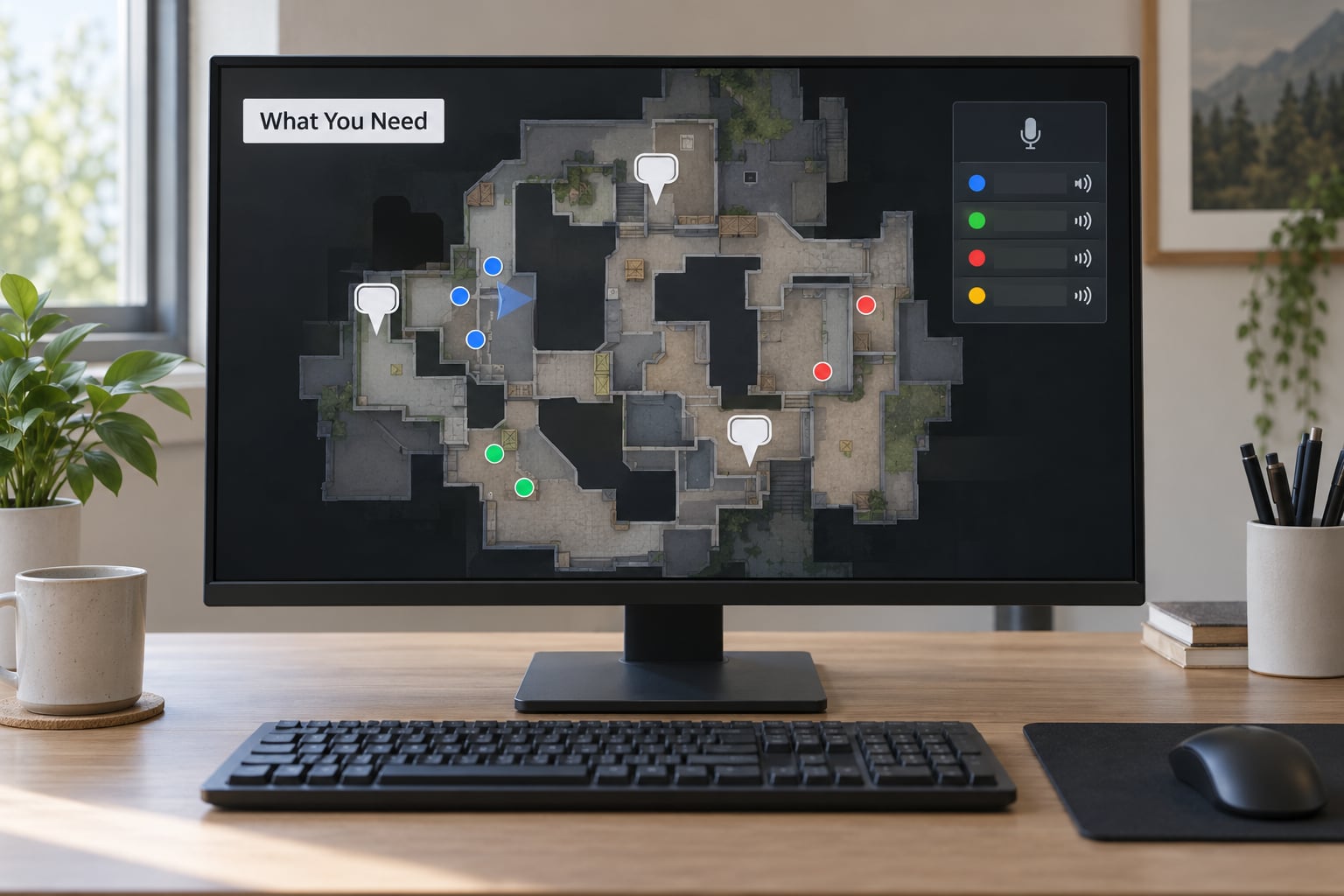
You need four things, and only one of them is software.
A comms channel that works
Voice is the standard. Push-to-talk beats open mic in every shooter I have played, because it stops background noise from covering a real call. If your team will not use voice, text chat plus the ping wheel still works, just slower.
Check your mic actually transmits before a ranked match. Two seconds of “can you hear me” saves a whole game of silent frustration.
Shared location names
Everyone has to be pointing at the same piece of map when they say “mid”. This is where most beginners stall: one player calls the centre lane “mid”, another calls it “top mid”, a third says “market”. Three words, one position, no agreement.
Learn the names real players use in your game first, then standardise with your team. Players have posted this exact problem on community threads: every callout chart labels the same corner differently, and the blunt reply from regulars is that you just have to learn the callouts and use them consistently.
An agreed shorthand
Shorten the long ones once and use the short version forever. Two-letter site names, “saving” instead of “saving position”, “one” for a single enemy, “no util” for a dry push. Agree on these in the first ten seconds of the lobby and stop renegotiating mid-round.
Enough game knowledge to know what matters
You do not need to memorise the whole map. You need to know which spots hold enemies, where your team has utility, and which chokepoints you cannot take alone. The beginner ask in most community threads is exactly this: learn the names for positions on the map and how to communicate properly, because giving your team as much usable information as possible is what wins rounds.
Step-by-Step: How to Use Callouts in Team Shooters
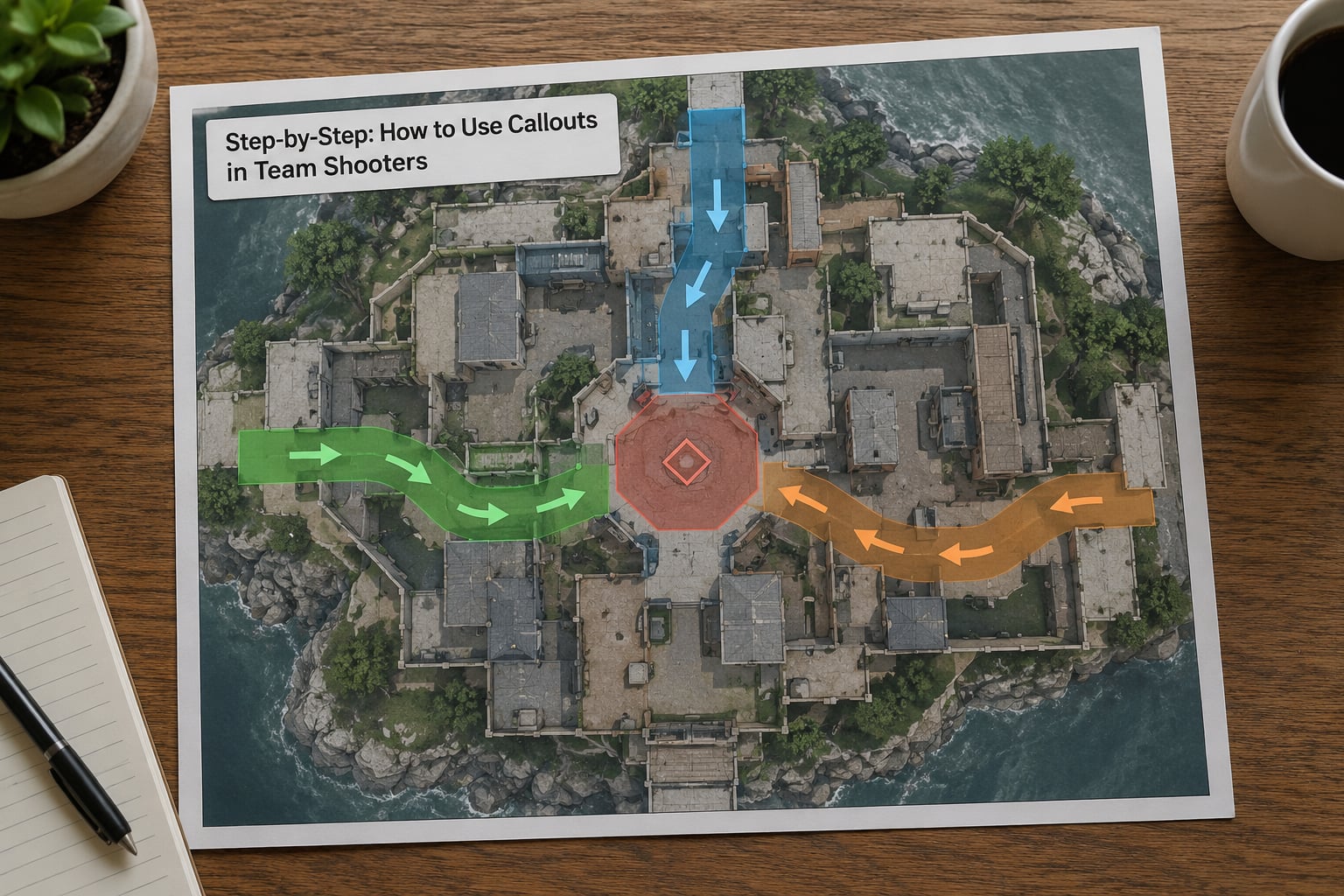
Step 1: Share your plan before you touch the site
Say where you are going and roughly when. “Going A long, ten seconds, I’ve got my flash.” Your teammates can now decide whether to trade, rotate or hold, and they are not guessing.
Step 2: Call the enemy, not the feeling
The moment you see or hear someone, name the location, the count and the pressure. “One B main, close, no util.” Three pieces of information, under three words each, which is the length most short-form callout advice lands on.
Step 3: Mark what you did not see
“B main clear” is as valuable as the contact call. It stops a teammate from re-peeking the same angle and it tells the anchor whether to rotate.
Step 4: Update instead of repeating
Old information is worse than none. If the enemy moved or died, say so immediately. “B main was a fake, they’re A” prevents a whole team from dying to a bad read.
Step 5: Call the objective, not just the fight
Report the state of the site as it changes. “Planted A, twenty seconds,” “defusing,” “defuse is half.” Those three calls decide more rounds than any early peek call.
Step 6: Regroup after the fight
Say who is left and where to collect. “I’m low, tree, bring me up” or “rotate B, I’m one shot.” Teams that reset after a lost trade win far more than teams that keep feeding the same choke.
How to Give a Clear Enemy-Position Callout
A usable enemy callout has three parts: a landmark, a count, and a threat level. Anything longer gets cut off by gunfire, and anything shorter gets misread. Swap vague calls for these:
Not “over there somewhere” but “one tree, close”. Named landmark plus distance, so your teammate already knows which corner you mean.
Not “they got a guy” but “two mid bottom, close”. The count and the position let your anchor decide whether the site is safe to hold.
Not “back planters maybe” but “back link, one, quiet”. Settles the name and flags a silent hold that is hard to hear coming.
Not “I think she’s B” but “unsure, sounded B main”. Marks low confidence so nobody commits utility or a rotation on a guess.
Learn the real names per game before you worry about style. In Valorant, A Long, A Short, Mid Bottom, Mid Courtyard, B Main, Back Link, Boathole, Tree, Zip and Elbow cover most of what you will ever need. In CS2 the vocabulary is Short, Long, Mid, Banana, Ticket, Pit, Ramp, Xbox and spawn names like CT Spawn or T Spawn. In Apex Legends people call ring, zone, building, rooftop and stairs. Rainbow Six Siege runs on a two-letter system for each room, plus objects inside them like CCTV and Main Stairs.
If you only memorise one strange-sounding name, make it Elbow on Valorant. It is the corner on A Long that bends, where attackers peek around and defenders hold a tight angle, and beginners routinely misread it as a doorway.
How to Call Out Rotations, Objectives, and Support
Not every callout is about an enemy. Roughly half of useful team communication is movement, objectives and support, and it is the half most players skip.
Rotations. Announce the departure and the destination together. “Rotating B through tree, ten seconds” lets the anchor start the retake early instead of holding a site that is already lost. Add whether you are safe, because “rotating B, low HP” changes whether your team contests or lets you go.
Objective status. State what happened, not what is about to happen. “Planted,” “one shot on the defuse,” “spike down, rotate” are all complete sentences that arrive when they matter.
Flank warnings. The highest-value defensive call in the game is short. “Flank, stairs.” Two words, and a whole site stops over-committing to the wrong lane.
Requests. Ask for one specific thing. “Need a smoke mid” beats “I need help.” Specific requests get answered; vague ones get ignored, which teaches your teammates to stop listening to you.
Short responses. Confirm and move on. “Copy,” “on my way,” “no util.” Long replies during a live fight cost your team the round.
How to Confirm and Update a Callout
Unverified information spreads. Someone hears “A main,” repeats it to a teammate, and suddenly four players have committed to a lane that was empty. Three habits stop that.
First, mark your own clears out loud even when nobody asked. Silence is what lets a stale callout live on. Second, use confidence words: “sure” versus “unsure.” Nobody minds hearing the second one, but everyone dies on the first one. Third, correct loudly and immediately when something changes. “Scratch that, they’re boosting A” costs a second and saves the round.
If nobody is making calls, you can still do your job well. Enemy positions, clears and rotations are useful even when nobody answers, and a team that hears one clear voice usually starts answering.
Common Mistakes
Vague directions
“Somewhere near the side of the road” is the single most reported frustration in shooter comms threads. Every vague call has a fix: swap it for a landmark your teammates already recognise.
Callout drift
When one player says “back planters” and another says “A back,” the team has no shared map. Pick the name the community uses, write it down in your team channel, and never renegotiate mid-round.
Talking over teammates
Two callers at once means neither lands. Let one player own contact calls and the other own rotation and objective calls, and swap on the next half.
Over-calling
Constant narration buries the useful information. Call contact, clears, objectives and requests. Leave out what you are doing every second.
Never confirming
Calls with no close-outs leave your team playing a situation that ended ten seconds ago. Clear, dead, gone, reset. Short and immediate.
Inventing names
Fear of sounding wrong is what silences beginners. A slightly odd name is fine; no name at all costs your team the information you had and nothing else.
Frequently Asked Questions
What are callouts in gaming?
Callouts are short, standardised statements you give your team to describe where an enemy is, where you are, what you are doing, or what you need. In shooters they are usually spoken over voice comms or sent through the ping system. A good one names a map landmark, adds a count or a distance, and stays under about three words, for example two A long, close.
What is the purpose of a callout?
The purpose of a callout is to turn raw information into coordinated action. A teammate who hears one B main knows whether to rotate, hold an angle, throw utility or back off, without needing to ask you a follow-up question. Teams that use specific, actionable callouts rotate faster, catch flanks and stop trading rounds from unclear fights.
What are some Valorant callouts?
The most used Valorant callouts cover the standard lanes on every map: A Long, A Short, Mid Bottom, Mid Courtyard, B Main, Back Link, Boathole, Tree, Zip and Elbow. Elbow is the bend on A Long where attackers peek around the corner and defenders hold a tight angle. Learn these ten first and you can describe almost every fight you see.
How do you give good callouts in Rainbow Six Siege?
Siege is built on its two-letter system, where every room and stairwell has a letter code. Attach the object and the threat to it: one defender, CCTV, or hatch is open, flank. Name the floor, the angle and the count, keep it short, and confirm when an angle is clear. Practice in a private lobby with an agreed shorthand before taking it into ranked.
How do I communicate when my teammates say nothing?
Do not wait for the team to start. Call enemy positions, marks and clears anyway, because even silent teammates adjust their play when they hear accurate information. Keep to contact, clears and rotations, avoid complaining about the silence, and expect answers to follow within a few rounds. The shortest calls get the most replies.
How many callouts do I need to learn?
Ten to fifteen per map is plenty for most ranks. Cover the main lanes, both sites, one rotation path and the common hiding spots, and treat the rest as optional. Depth matters less than consistency: a team that agrees on fifteen names beats a team that knows forty and never settles on any.
Start with one habit this week: call the count, the landmark and the distance every single time you make contact, then say clear when you stop seeing them. Fifteen minutes in a private lobby with your team agreeing on names will do more than a month of reading guides, and your rounds will feel different by the third match.