Most competitive games need roughly 100 to 300 hours to reach competent play, and 500 to 1,000 hours to hold a rank above average in your lobby. Those numbers move a lot depending on genre, how often you play, and whether you queue or actually practice.
The honest answer is that hours get you partway, and method gets you the rest. A player with 200 focused hours usually beats a player with 600 hours of queue time, which is why the same number of hours produces wildly different results across the ladder.
This guide breaks the timeline into phases, compares how long different competitive genres take to click, and gives you a practice system that makes short sessions count. Updated for 2026.
Table of Contents
- 1How Long Does It Take to Get Good at a Competitive Game?
- 2The realistic hour benchmarks by skill tier
- 3The three phases of competitive improvement
- 4What Does Getting Good at a Competitive Game Actually Mean?
- 5Which Competitive Games Usually Take the Longest to Master?
- 6How Many Hours per Week Do You Need to Improve?
- 7How to Improve Faster Without Grinding
- 81. Isolate one weakness
- 92. Match the drill to the problem
- 103. Analyze the losses
- 114. Play opponents who beat you
- 125. Test and record
- 13What Is the Fastest Way to Build Game Sense?
- 14How Can You Tell That You Are Actually Getting Better?
- 15How Do Coaching, Replays, and Team Practice Change the Timeline?
- 16Why Can Improvement Feel Like a Plateau?
- 17Frequently Asked Questions
- 18How long does it take to get good at a competitive game?
- 19Is 30 minutes a day enough to improve at a competitive game?
- 20Should beginners play ranked matches while learning?
- 21Can older players or players with no gaming background become competitive?
- 22When should I stop improving one game and try a different one?
- 23Start With One Measurable Improvement
How Long Does It Take to Get Good at a Competitive Game?
It takes about 100 to 300 hours of play to become competent at a competitive game, and 500 to 1,000 or more hours to reach the top tier of a ranked ladder. Time and improvement both depend on game complexity, your starting experience, how often you play, whether you get coaching, and what you count as good.
The realistic hour benchmarks by skill tier
| Skill tier | Hours of play | What it looks like in practice |
|---|---|---|
| Learning the game | 0-100 hours | Controls, menus, abilities, basic map or stage layout |
| Competent | 100-300 hours | Stop dying to obvious mistakes, contribute consistently in most matches |
| Above average | 300-600 hours | Win your lane, hold your position, beat players at your own rank most of the time |
| Top of the ladder | 600-1,000+ hours | Sitting in the top slice of the ranked distribution, often top 10% |
| Tournament level | 1,500-5,000+ hours | Structured team play, scrims, opponent preparation |
Those ranges come from how players describe their own climb rather than from a controlled study, and that matters. Nobody publishes a double-blind trial on Valorant. The numbers are self-reported, which is why they cluster rather than land on a single tidy figure.
The three phases of competitive improvement
Phase one is learning the game: controls, systems, map, rules. This phase is fast and boring, and most people blow through it without noticing.
Phase two is mechanics and consistency. Your inputs stop being a conscious thought, you stop feeding easy deaths, and your performance stops depending on how the match went ten minutes ago. This is usually the longest grind, and it is where most players stall without knowing why.
Phase three is game sense: the decisions about what to do with the mechanics you already have. It arrives late for almost everyone, and it is the phase that separates a mid-pack player from a top-10% player with a similar hour count.
What Does Getting Good at a Competitive Game Actually Mean?
Good means you reliably outperform players who have invested about the same amount of time as you. That is a sharper definition than a rank label, because a rank moves with matchmaking, smurfs, and teammate luck.
- Mechanical consistency. You make the same shot, the same combo, or the same positioning play at the same rate whether you are up five rounds or down five.
- Game knowledge. You know what the opponent is likely doing next, what the numbers on the ability bar mean in context, and which fights to avoid.
- Decision-making speed. You choose in seconds, not in deliberations. Slow correct decisions lose the same as fast wrong ones.
- Adaptation. When someone beats you twice with the same plan, you change something on the third attempt.
- Comms and team play. On a five-stack you make the team better, not just your own stat line.
- Performance under pressure. Your win rate in your tenth match of a night holds up, instead of collapsing.
A quick self-check: track your last 30 matches and count how many losses contained one decision you would call avoidable. If that number sits around ten or more, your mechanics are fine and your problem is decision-making. That distinction saves people hundreds of wasted hours.
Which Competitive Games Usually Take the Longest to Master?
Fighting games sit at the slow end because the knowledge ceiling keeps rising: every character has options, the same matchup plays out differently on different stages, and defensive play punishes guessing. Tactical shooters sit in the middle with a steeper decision curve than aim curve. Chess sits at the other extreme, where hours matter less than pattern library and calculation depth.
| Genre | Hours to competence | Hours to top ladder | Why the curve looks like this |
|---|---|---|---|
| Card and tabletop strategy | 200-400 | 1,000-2,000+ | Pattern library matters more than execution speed |
| Tactical shooter | 200-400 | 800-1,500+ | Utility, positioning and team protocols stack on aim |
| MOBA | 150-300 | 700-1,500+ | Huge champion and item pools, plus macro decisions |
| Aim-heavy FPS | 100-250 | 400-1,000 | Mechanics dominate and can be trained directly |
| Battle royale | 100-250 | 600-1,200 | Endgame decisions matter more than raw aim |
| Sports and racing sim | 80-200 | 400-800 | Short skill chain, fast feedback loop |
| Fighting game | 300-600 | 1,500-3,000+ | Matchup knowledge keeps expanding past the 1,000-hour mark |
One community data point worth remembering: a player posting on r/FPSAimTrainer reported hitting Master after 753 hours and laid out where they started against where they ended. It is a single self-report, but it sits neatly inside the 400-to-1,000-hour band above.
The counter-example matters just as much. On r/RocketLeagueSchool, a self-described 5k hour C1 player posted that they were desperate to improve. Five thousand hours of playing had not produced the next tier. Nobody can read their session log from the outside, but the post is the single best argument against treating raw hours as the variable.
Battle royale communities are more blunt about ranked being an inefficient practice tool. Consensus in r/FortniteCompetitive is that climbing with ranked alone gets you so far, and placement-level gains need structured practice and real tournaments. In r/CompetitiveTFT, people land in the same place with hours: six to eight a week minimum to keep up with the meta, and four to six just to stay current.
Competitive fighting game players already budget like this. On smashboards.com they describe playing three to four hours in sessions plus another one and a half to two at weekly events, landing somewhere between 7.5 and 14 hours a week. That is a job, not a hobby.
How Many Hours per Week Do You Need to Improve?
Ten focused hours a week is the practical minimum for steady improvement in most competitive games. Below five, you spend most of the session remembering what you forgot. The number that matters is not weekly hours but how much of that time carries feedback.
| Hours per week | Time to 300 hours | Time to 1,000 hours | Who it suits |
|---|---|---|---|
| 5 hours | About 15 months | About 4 years | One long evening and a couple of short sessions |
| 10 hours | About 7.5 months | About 2 years | Most adults with a job and a controller, not a team scrim schedule |
| 20 hours | About 3.75 months | About 12.5 months | Students, semi-pros, tournament preparation |
| 40 hours | About 7.5 weeks | About 6 months | Full-time practice and team play |
Those are calendar conversions, not promises. Rank climbs are non-linear, and roughly a third of an hour in a queue is lost to loading, lobby waiting, comms and banishment after a tilt. Budgeted time and played time rarely match.
Sessions matter as much as total hours. Ninety focused minutes beats a four-hour binge, mostly because attention drops long before the session ends and the tail of a marathon is queue time rather than practice. Competitive fighting game players already structure it this way with 3-4 hour sessions, but most players do better with two to three shorter blocks plus one review session.
Spaced practice also beats the marathon. The same three hours across Monday, Wednesday and Saturday outperforms nine hours on a Saturday, because the mechanics consolidate overnight and you return to each drill slightly sharper than you left it.
How to Improve Faster Without Grinding
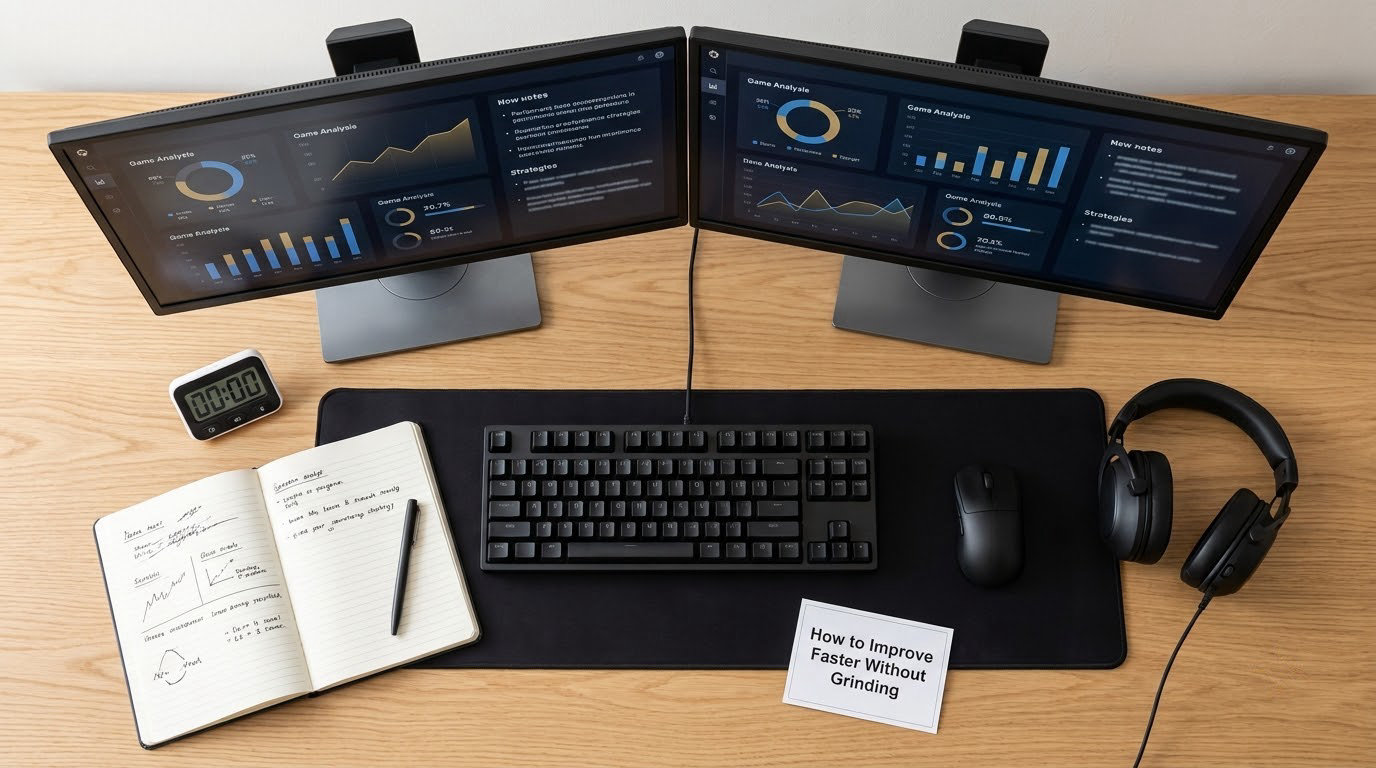
Most wasted gaming hours are queue time, and the fix is a repeatable loop rather than more sessions. Five steps, run over two-week blocks, cover most of what coaching would sell you.
1. Isolate one weakness
Pick a single measurable thing and leave everything else alone for two weeks. Not aim generally, but first-shot accuracy on the second round after a death. If you cannot name it in one sentence, it is too broad to train.
2. Match the drill to the problem
If the gap is mechanics, use a training range or aim routine with immediate feedback. If the gap is decision-making, ranked or unranked matches beat drills, because decisions only appear in messy real situations. If the gap is team play, queue with a fixed group.
Players on r/VALORANT report reaching the top part of the ladder within a few years of playing, with consistent deliberate practice as the thing separating the climbers. Same genre, same time budget, different method.
3. Analyze the losses
Watch two losses after every session, full speed if you can spare it, half speed if not. Write one sentence per match on what cost you the round. Over 100 matches this produces a ranked list of your actual mistakes instead of a feeling about which ones repeat.
4. Play opponents who beat you
Comfort opponents cannot teach you anything new. Play slightly above your level where the game punishes bad habits, and stay below it when you need volume. Overwatch competitive forums routinely describe around 1,000 hours to reach aim levels that beat veteran friends, which is roughly when the practice has to get uncomfortable to matter.
5. Test and record
After two weeks, compare the metric. Same conditions, same time of day if possible. If nothing moved, the drill is wrong rather than the effort, so swap it. Changing one thing at a time is the difference between a program and a collection of attempts.
What Is the Fastest Way to Build Game Sense?
Game sense comes from watching matches with a question attached. Watching for entertainment teaches almost nothing, because you absorb highlights rather than decisions.
Start with map and system knowledge: routes, timings, sightlines, objective windows, the numbers behind each ability. Players without this try to win fights that the map already made unwinnable.
Then study opponent tendencies. Most players repeat a default opening for hundreds of hours. Watch ten matches from one skill level, note what they do in the first thirty seconds, and you will find the counter long before you find it in live play.
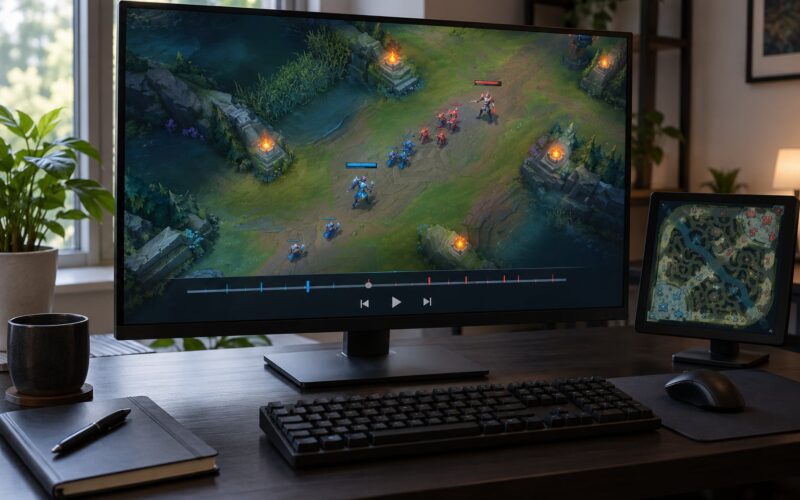
Review your own replays last, because it is the highest-value habit and the easiest to skip. Mark the moment the round was decided, not the moment you died. A marker at your death is a symptom; a marker at the decision three seconds earlier is the lesson.
Ask better questions too. Why did I take that fight with three abilities down? What information did my opponent give me, and did I use it? Which of my two gold values was better here? Questions like these train the part of your brain that decides, not the part that clicks.
How Can You Tell That You Are Actually Getting Better?
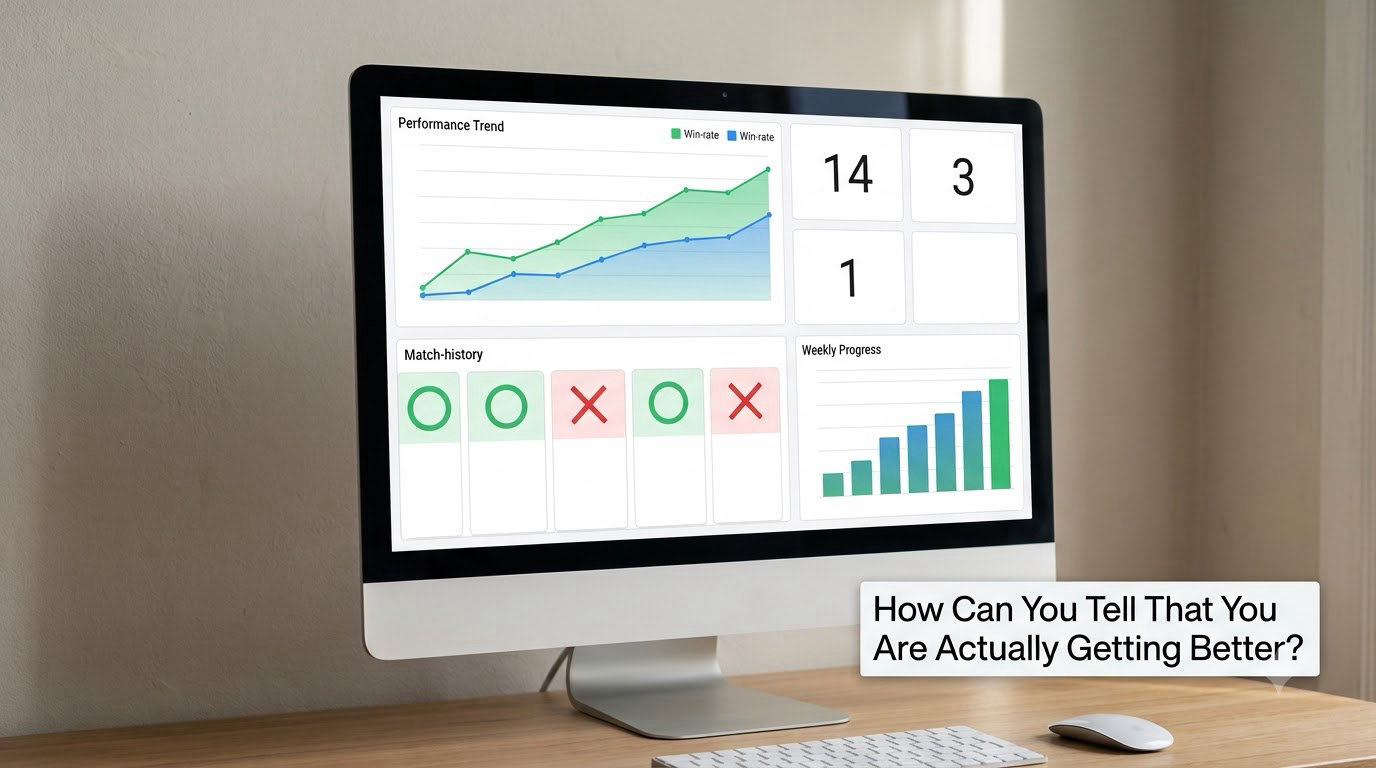
Rank is a noisy signal, so track four things alongside it. Win rate against players at or slightly above your level, your mistake count per match, the average round or fight length you survive, and how quickly you make decisions under pressure.
Those four move before rank does. A rank can sit still for two weeks while win rate against stronger opponents climbs steadily, because your matchmaking is adjusting to a real improvement that the badge has not caught up with.
Consistency beats peak performance as a marker. One great night means little. Twenty matches in a row with a similar decision error rate means something changed, and you can point to what.
How Do Coaching, Replays, and Team Practice Change the Timeline?
Solo self-practice is the cheapest option and the least efficient, because nobody is there to tell you which of your two bad habits is costing more. Replay review is the best value step up: no cost, immediate feedback, and it shortens the loop between playing badly and knowing why.
Coaching compresses the timeline most where the game has hidden structure. Fighting game players gain the most, because matchup-specific knowledge is hard to self-teach, and a coach can hand you the three strings to run in the lab instead of letting you guess for 300 hours. Tactical shooters gain the most on positioning and utility usage for the same reason.
Premade teams change the math differently. A fixed group with shared calls and roles converts individual improvement into team improvement, and it cuts the variance from random teammates that makes solo progress feel erratic. It also requires the calendar commitment that most adults do not have.
Tournament preparation is its own category. You are not learning the game anymore, you are learning a specific opponent in a limited time, which is a different skill with a much shorter half-life.
Why Can Improvement Feel Like a Plateau?
A plateau usually means the hours stopped carrying feedback. These are the common causes, in the order I would check them.
- You practice the wrong skill. Queueing endlessly when your actual gap is game sense feels productive and builds nothing.
- You only play comfortable maps or modes. Improvement stops the moment nothing challenges you.
- You review nothing. Without review you repeat mistakes identically for hundreds of hours.
- You chase quantity. Six hours of unranked filler produces slower progress than ninety minutes of range work.
- You change habits too fast. Rewriting your whole approach every week leaves nothing to consolidate.
- Your opponents and matchmaking keep changing. A noisy win-rate curve hides a real upward trend for weeks at a time.
- Tilt is eating your sessions. Players frequently report losing hours to anger rather than to learning, and those hours never show up in a highlight reel.
The fix is unglamorous: stop queueing for two weeks, pick one measured weakness, drill it with feedback, and play a little above your level. Most plateaus break there. Some do not, and the ones that do not usually point at a role or a game that fits you worse than the one you are in.
Frequently Asked Questions
How long does it take to get good at a competitive game?
Most competitive games take 100 to 300 hours to reach competent play and 500 to 1,000 or more hours to hold a rank in the top tier of your lobby. Fighting games and strategy titles sit at the slow end of that range, while sports sims and aim-heavy shooters reach competent play fastest. The number moves a lot depending on how often you play and how much of that time includes feedback.
Is 30 minutes a day enough to improve at a competitive game?
Yes, and it beats nothing. Thirty minutes of targeted practice most days adds up to around 260 hours a year, which is enough to reach competent play in most genres. The caveat is what happens in those 30 minutes: a fixed routine on your known weak point beats 30 minutes of queueing, because queueing rarely tells you what went wrong.
Should beginners play ranked matches while learning?
Eventually yes, but not in the first 30 to 50 hours. Early ranked play punishes exactly the mistakes you are still making, and the loss rate can push people out before habits form. Learn the systems first, then use ranked as the place decisions get tested, since those decisions only appear in messy real matches.
Can older players or players with no gaming background become competitive?
Reaching the upper ranks later in life is realistic; competing for a professional contract is a different conversation. Reaction speed and raw reflex decline gradually, but knowledge, positioning, comms and decision-making keep improving for decades. Players who start in their twenties or thirties regularly reach high amateur ranks, and community members who felt late to the game often found their late start made them more deliberate.
When should I stop improving one game and try a different one?
Stop when you have hit a ceiling you cannot name, not when you have a bad week. If two focused months of targeted practice move none of your measured metrics and you have no idea which skill to train next, the game is not giving you feedback. At that point the sunk hours matter less than whether you would enjoy the work, because improvement requires a lot more practice, not less.
Start With One Measurable Improvement
Pick one thing you can measure this week. Not get better, not climb, one thing: first-shot accuracy, deaths before the first item, rounds survived after a bad opening.
Run a two-week block on it, log the number each session, and review two losses after every block. When the metric moves, add the next weakness. When it does not, change the drill rather than the effort.
That is the whole system. It is faster than grinding, and it works at ten hours a week as well as it does at thirty.