Updated for 2026. This guide works in any competitive game — MOBAs, battle royales, shooters, fighting games, card games, chess and poker.
Tilt is the state where a loss takes over your decision-making. You start making plays you would never make in a calm game, chase revenge on the person who killed you, blame teammates who did nothing wrong, or quit mid-round. So how to stop tilting after losses comes down to a short fixed routine between matches: exit cleanly, take a real break away from the screen, breathe, write down one thing you controlled, then queue again only if you are actually ready.
That routine takes about 20 minutes and it works in ranked shooters, in solo queue, at the chess club and at a home poker table. It is not about never feeling frustrated. Frustration is normal and it passes on its own. Tilt is what happens when the frustration keeps running while you keep playing.
Most players already know the advice and ignore it anyway. “Just take a break” lands badly when you are mid-loss-streak and convinced the next game will fix it. The fix is making the next action specific enough that you can do it while still upset, which is what the seven steps below are for.
Table of Contents
- 1What You Need
- 2Step-by-Step: How to Stop Tilting After Losses
- 31. Notice the Signs of Tilting Early
- 42. End the Match Cleanly
- 53. Reset Your Body Before Your Mind
- 64. Separate the Result From Your Identity
- 75. Review One Thing You Controlled
- 86. Make a Simple Plan for the Next Match
- 97. Queue Again Only When You Are Ready
- 10Common Mistakes
- 11Tips for Keeping Tilt Under Control
- 12Frequently Asked Questions
- 13How long should I wait before playing another match after losing?
- 14Why do I keep tilting even when I know I am frustrated?
- 15Does taking deep breaths really help with gaming tilt?
- 16How should I handle a toxic teammate after a loss?
- 17When is it better to stop gaming for the day?
- 18What if I cannot stop feeling angry after competitive losses?
- 19Your First Move After the Next Loss
What You Need
The whole routine needs three things, and all of them are free.
- About 20 minutes away from your screen. Long enough for your body to come down from the fight-or-flight state, short enough that you actually do it. Five minutes of scrolling is not a break.
- A way to track the result. A match history, a scoreboard, a notebook, anything that tells you how the session is going without you having to remember. People who rely on memory tend to remember the losses and forget the wins.
- A way to walk away from the screen. A second room, a hallway, a kitchen. Standing up matters more than the duration.
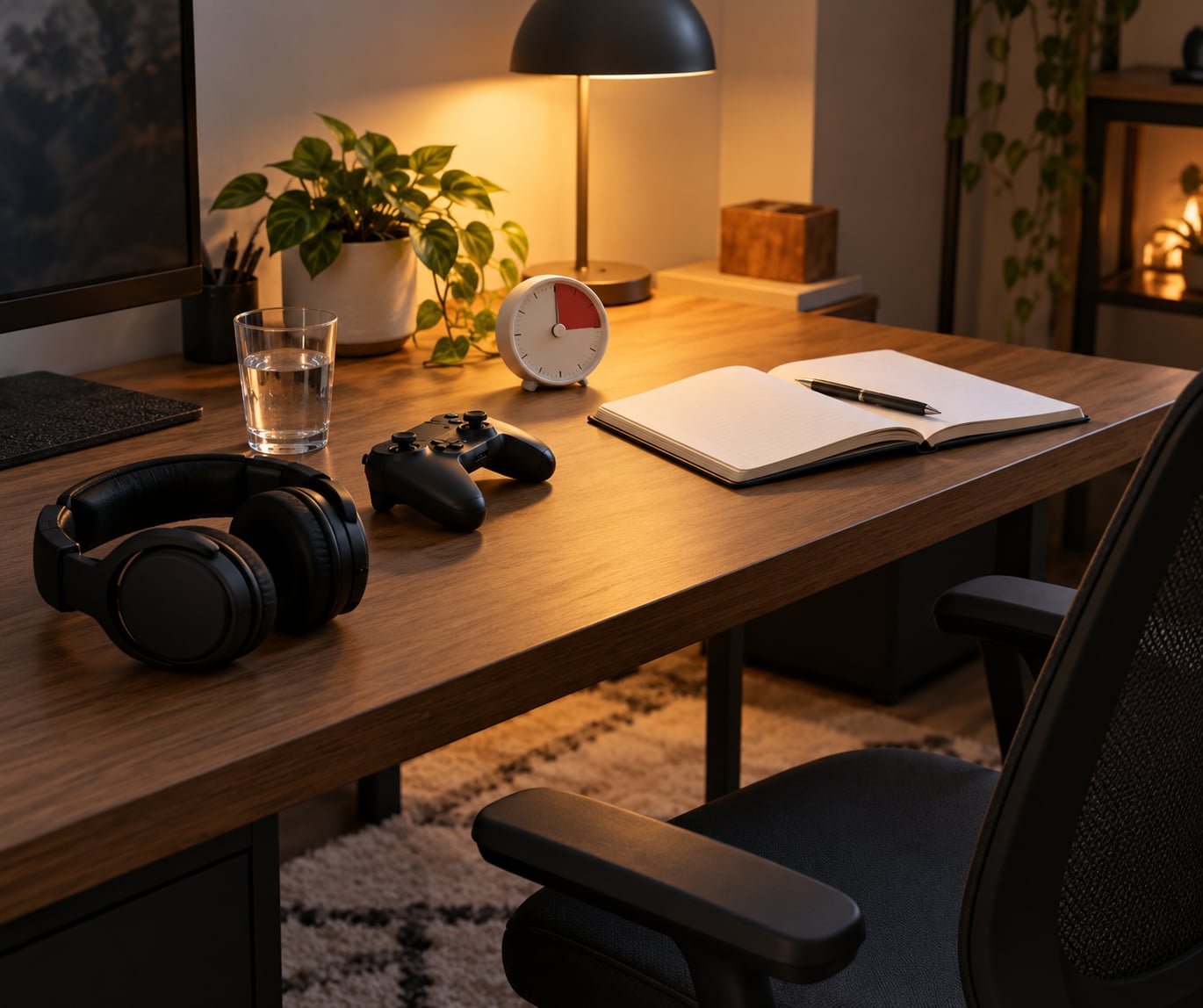
Optional tools that make it easier: a kitchen timer so you are not guessing at 20 minutes, a notebook or notes app for the one-takeaway review in step five, and music or a podcast for the walk. None of them are required, and buying gear is not the bottleneck. Almost every tilt problem is a decision problem, not an equipment problem.
Step-by-Step: How to Stop Tilting After Losses
This is the routine. It runs in order, and it takes roughly 20 minutes end to end. Most of the time you only need the first three steps — they are the ones that stop you from queueing while you are still angry. The last four are what keep the session from turning into a losing streak.
1. Notice the Signs of Tilting Early
Tilt rarely arrives without warning. It starts with small, boring changes that most players dismiss.
Physical signs show up first, before you notice anything mental:
- Breathing gets shallow and high in the chest
- Jaw, shoulders or hands tighten
- Heart rate stays up between actions
- Bouncing leg, restless shifting, heat in the face
- Stomach feels tight or nausea settles in
Behavioural signs follow:
- Starting the next match before the previous one is reviewed
- Typing in chat right after dying, or after a teammate dies
- Changing characters, positions or loadouts for no tactical reason
- Refusing to play support, jungle or any role you dislike
- Refusing to play anything at all, mid-session
- Fixating on the scoreboard, the rank or the enemy who killed you
- Saying “one more” when you have said it three times
One League player described the cascade better than any guide can: a teammate abandoned a winnable game late because he disliked two other players, and by the end three more people were visibly tilted. Nobody in that lobby decided to start a fight. It happened one message at a time.
Catching the physical signs early is what gives you a choice. Recognising tilt halfway through a loss, after you have already queued again, is much harder. The rule I use: if my breathing has changed and I have not noticed it doing it, that is the signal. Stand up then, not after the next death.
Fatigue wears the same mask. Players routinely blame tilt when they are simply exhausted — four hours in, no food, a bad day at work. If the restlessness shows up in sessions you are otherwise fine with, the problem is recovery, not mindset.
2. End the Match Cleanly
The most expensive decision in gaming happens in about two seconds: the queue button after a loss you did not want. Everything else in this routine is easier if you make that one decision deliberately.
Run the exit in this order:
- Do not accept a rematch, boost or group invite. Not “not yet”. Not at all.
- Finish the small post-match tasks. Claims, progress, a single glance at your result. Leaving them triggers the notification anxiety that pulls you back.
- Close the game entirely. Not minimised. Closed.
- Write down when the next session will start — a time, not a feeling. “Tomorrow after work” beats “when I feel ready”, because feelings are exactly what is compromised right now.
People resist the break far more than they admit. One chess poster took three weeks off and described being scared of starting again, which is a striking admission. If returning sounds heavy before you have even returned, the avoidance is not discipline, it is a tilt symptom. The written end time is what makes coming back cheap.
On r/VALORANT, one user described the default honestly: most of the time they just rage quit and take a snack. That is not a character flaw. It is the fastest available behaviour when you are upset, which is exactly why it needs a replacement routine.
3. Reset Your Body Before Your Mind
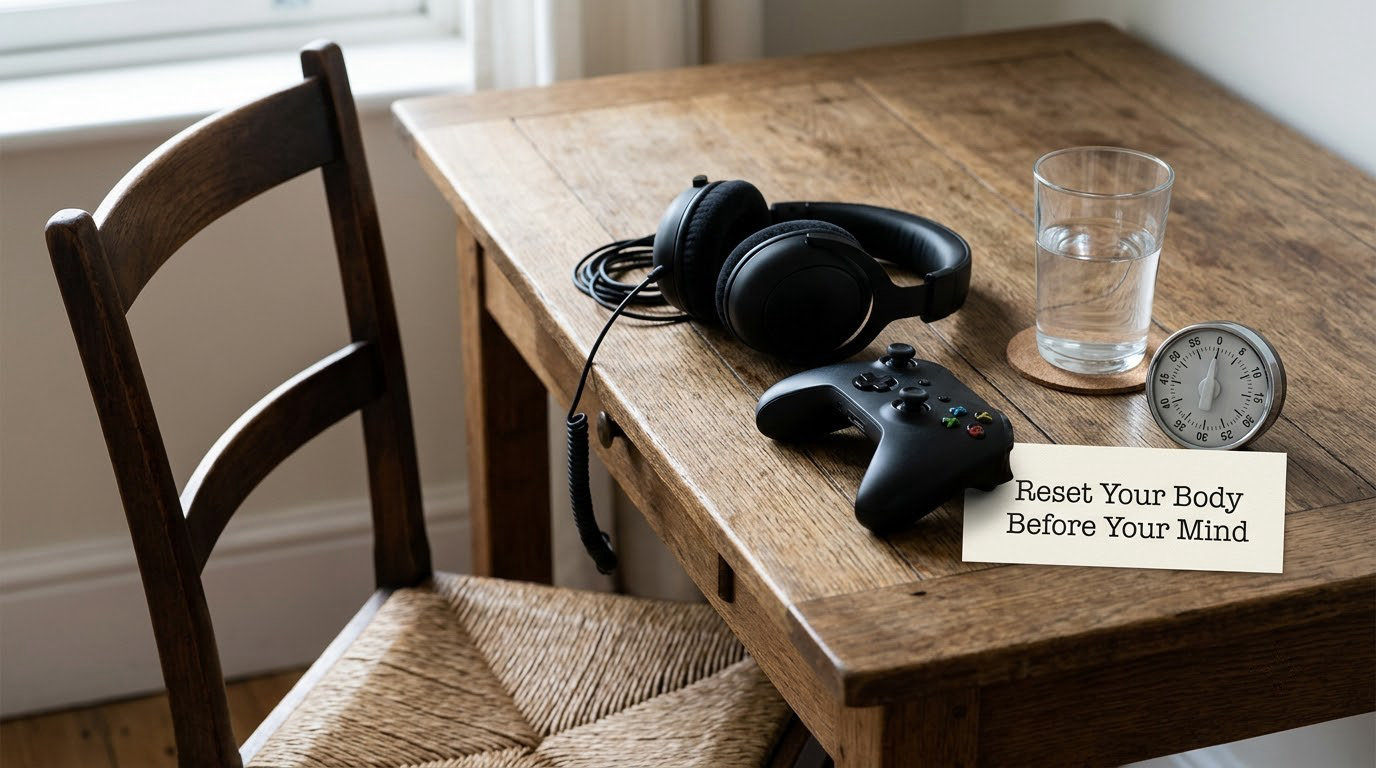
You cannot think your way out of a body that is still pumping adrenaline. Give it two to five minutes of physical attention and the urge to queue fades on its own.
The sequence that works for most people:
- Stand up and leave the desk. Different room, different light, no screen in sight.
- Box breathe: 4 counts in, 4 counts hold, 4 counts out, 4 counts hold. Five rounds is about two minutes. The long exhale is the part that matters — it is what activates the parasympathetic side of your nervous system, the brake on the stress response. Most people breathe fast and shallow when tilted; the count fixes that without you having to notice it.
- Drink water. Then stand in front of a sink or a window for a minute and let your eyes focus on something distant.
- Change one sensory input. Music, a walk outside, a different room. Novelty pulls attention off the loop.
If you are especially activated — shaking, flushed, chest tight — extend it. Take a 15-minute walk, get water on your forearms and the back of your neck, and do ten slow exhales where the out-breath is twice as long as the in-breath. Do not try to review the game while your hands are still shaking. You will only find things to be angry about.
Add one physical tool if you like: progressive muscle relaxation. Clench your fists and jaw hard for five seconds, then release completely, and work down to your shoulders. Doing it once is usually enough to notice how much tension you were carrying.
4. Separate the Result From Your Identity
Tilt grows in the gap between an event and what you decide it means about you. The loss is an event. “I am bad at this and everyone can see it” is an interpretation, and it is the one doing the damage.
A neutral sentence works better than any pep talk, because it is accurate and it does not argue with reality:
I lost this match and felt frustrated. The feeling is real and it will pass.
Everyone says variations of the same idea. The most repeated distinction on the chess forums is the one worth stealing: did you play badly, or were you outplayed?
- You played badly — missed shots, rushed positions, ignored the plan. Stop analysing. Manage energy instead. Review later or not at all.
- You were outplayed — a stronger opponent beat your best play. Analyse it, and also step away, because there is nothing urgent to fix at 1am.
The chess.com thread treats recognising which of those happened as a real sign of maturity, and that is the right read. The highest-voted answer there is blunt: when you lose a game, stop playing and analyse it thoroughly. The missing half of that sentence is the timing — thorough does not mean immediately, and it does not mean during the next match.
Cognitive reappraisal is the formal name for what the neutral sentence does. You change the interpretation of the event rather than suppressing the feeling, and it holds up better over years than willpower does.
5. Review One Thing You Controlled
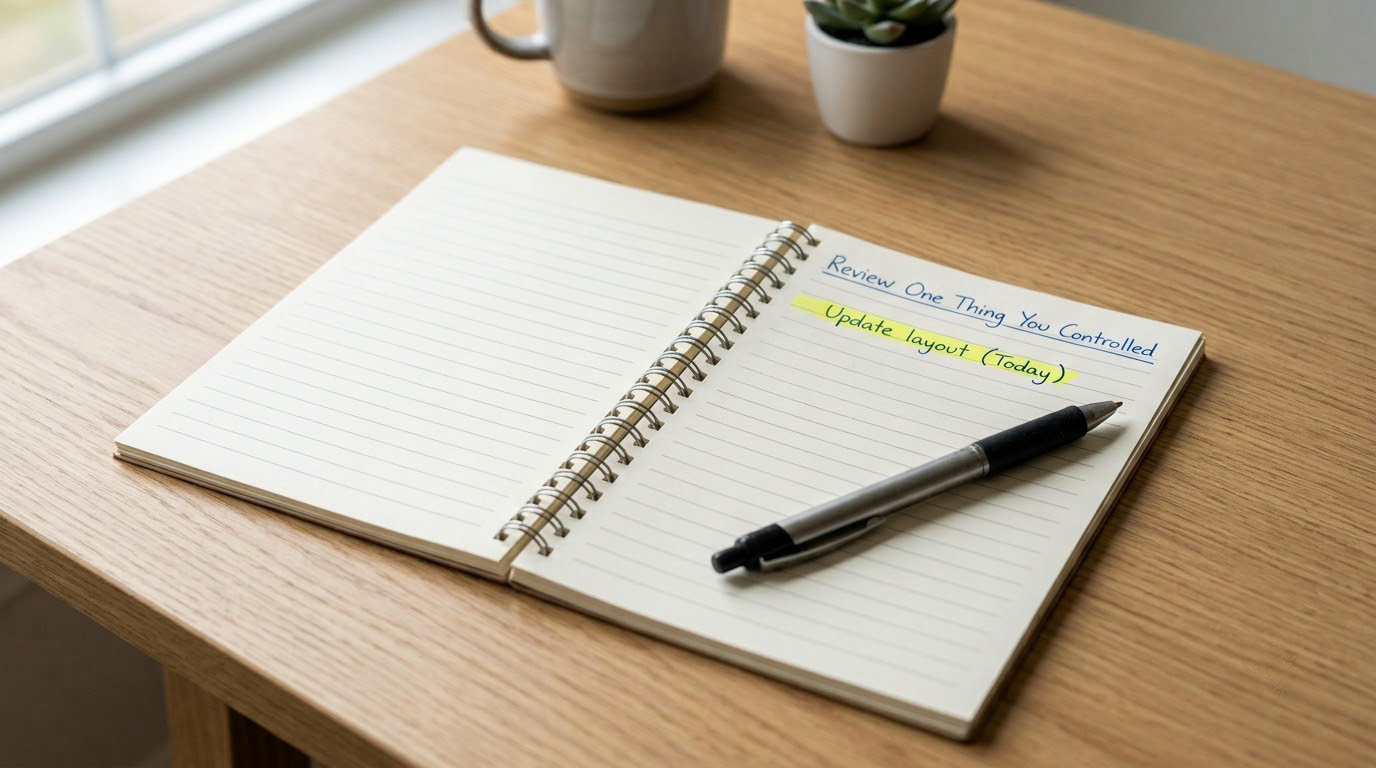
Post-game review is where good intentions go to die. Sitting through 40 minutes of replay hunting for every mistake is a punishment, and punishment is exactly what keeps you tilted.
Do a three-line review instead, capped at five minutes:
- One decision you controlled. Not the whole game. One. A rotation you called, a shot you took, a piece you left hanging.
- One lesson, in plain words. “I push when I am low on health.” “I open the same way every round.”
- One adjustment for the next match. Something small enough to actually do under pressure.
Write it down. A note you can re-read in 30 seconds before queueing does more than a review you half-remember.
If you keep tilting on the same losses, keep a trigger log for a week: date, result, what happened, what you were feeling before the game. Patterns show up fast. Most people find out their tilt is not about the game at all — it is about the person they queued with, or the two hours of sleep, or the loss that came right after a good one.
6. Make a Simple Plan for the Next Match
That is where the routine closes the loop: turn the lesson into one plan, and replace the impulse to react with an action you chose on purpose.
Every plan has three parts:
- A goal you control — a process goal, not a result goal. “Play my opening slowly” beats “win two in a row”. Nobody controls the second one, and chasing it is how a losing streak becomes a disaster.
- A personal rule — mute all chat, no all-chat, no reviewing during the match, no checking the score while it is running.
- A stopping condition, decided now — the part everyone skips.
Two concrete rules that do most of the work:
- The 20-minute cooldown. Twenty minutes away from the screen after a loss you did not want. Not five, not “until the queue is fast”.
- The two-loss walk-away. If you have lost twice in a row, stop for the session and look at the review. Some nights that saves 40 rating points. Others it saves your evening.
Cap the whole session too. Two to three hours with a 45-to-60-minute break in the middle. Past that point you are usually not improving anything, and the last hour is where the worst decisions come from.
Set the stopping condition while you are calm and write it down. Deciding how to stop tilting after losses after you have already lost four is how you end up at 2am requeuing for a win that was never coming.
7. Queue Again Only When You Are Ready
Not “when I want to”. When you are ready. Four questions, answered honestly:
- Is my breathing normal, or is it still fast and shallow?
- Can I name the one thing I want to do differently, without anger in it?
- Would I play this match if it turned out badly?
- Do I want to play, or do I want to win back the last one?
If the fourth answer is the real one, stop for the day. You are not punishing yourself; you are cutting a loss that has already happened. The rank number you are trying to protect is not going to recover in a match played by someone who is angry.
Three yes answers and one no means stop. Four yes means queue. That rule works because it does not require you to feel good first, which is not something practice gives you.
Common Mistakes
Most tilt advice fails because the obvious version of it is wrong. Here are the mistakes I see most, and what to do instead.
- Queueing immediately to erase the last loss. The next match is not a do-over, and you know it while you are pressing the button. Take the 20 minutes.
- Analysing every mistake in full. Five minutes, one decision. Then stop. Long reviews become a second game, and the second game is always lost.
- Muting a teammate and then stewing on them all night. Mute and disengage properly — stop reading their messages entirely. Half-muting keeps the argument running in your head.
- Forcing yourself to “stay positive” while angry. Suppression makes the next match worse, not better. Regulate the body first, then reframe. Body before mind, every time.
- Treating the loss as proof you should quit gaming. One bad session is data, not a verdict. The conclusion you draw in the first minute after a loss is the least reliable thought you will have all week.
- Blaming matchmaking, lag or the patch instead of reviewing. Sometimes that is genuinely the cause. Check it honestly, then accept the verdict either way and move on.
- Treating exhaustion as tilt. A bad session on four hours of sleep and no food is a recovery problem. Fix the recovery first and see if the tilt goes with it.
Tips for Keeping Tilt Under Control
Beyond the routine, a few habits stop the spiral before it starts.
- Set a realistic win goal before queueing. Two wins out of five is a normal evening. A goal you will miss most nights is a tilt generator by design.
- Practice one specific thing. Ten minutes of deliberate practice on one mechanic beats three hours of low-stakes queueing, and it gives you a win condition you control.
- Play with consistent people. A small group that communicates normally is worth more than any skill gap you close alone.
- Keep your communication boundaries clear. One rule, stated once: no flaming teammates in chat, ever. People who do not accept the rule do not get queued with.
- Schedule breaks before you need them. A fixed break every 45 to 60 minutes is better than waiting for your body to force one.
- Lead your team out of a tilt spiral. If someone on your team is spiralling, you set the tone. Signal intent to win, keep comms short and factual, and do not answer accusations — even correct ones, especially in the middle of a fight.
- Talk to someone you trust if it keeps happening. If the anger after losses regularly follows you into the rest of your day, that is worth raising with someone — a friend, a partner, a mentor, a counsellor or your doctor. Nothing to be dramatic about; it is the same move you would make for a shoulder that kept hurting.
Frequently Asked Questions
How long should I wait before playing another match after losing?
Give it at least 20 minutes away from the screen. Five minutes is not enough for your heart rate and breathing to come back down, and you will still be running on the loss when the next match loads. Add 15 to 20 minutes if you lost badly, and use the two-loss rule as your hard limit for the whole session.
Why do I keep tilting even when I know I am frustrated?
Because knowing is not regulating. The part of your brain reacting to a bad loss is fast and automatic, while the part that knows it is pointless runs slower. Your body also tightens and your breathing goes shallow before you consciously register the frustration, which is why self-awareness alone rarely wins. Change the body first, then the thinking follows easier.
Does taking deep breaths really help with gaming tilt?
Yes, because breathing is the one part of the stress response you can control on purpose. Box breathing with four counts in, four hold, four out, four hold lengthens the out-breath, which activates the parasympathetic nervous system and brings your heart rate down. Five rounds takes about two minutes and measurably takes the edge off the urge to queue immediately.
How should I handle a toxic teammate after a loss?
Mute them, then stop reading their messages rather than skimming them. Do not answer accusations, even accurate ones, because the argument escalates faster than the game did. If the behaviour is repeated, say once, calmly, that flaming ends the queue with them, then play with people who do not need managing. Your own composure is the part you control.
When is it better to stop gaming for the day?
Stop when the goal has shifted from playing well to getting even. Signs include checking your rank after every game, typing in chat right after dying, refusing any role, and queueing only to win back points. Two losses in a row is also a good trigger by itself. Two to three hours is a reasonable cap, with a real break before that if you can manage it.
What if I cannot stop feeling angry after competitive losses?
Some anger runs longer than a single session, and that is worth taking seriously rather than treating as a character flaw. If it regularly follows you into the rest of your day, disrupts sleep or relationships, or if gaming has gone from fun to something you feel you have to do, talk to someone you trust about it, or to a doctor or counsellor. It is a normal thing to raise and far easier to fix early.
Your First Move After the Next Loss
Close the game. Stand up, leave the room, breathe four counts in and four counts out for five rounds, and drink some water. Come back in about 20 minutes and write three lines: one decision you controlled, one lesson, one adjustment. Then set your plan and your stopping condition before you queue.
That is the whole routine. None of it is exotic, and none of it requires you to be a calmer person than you are right now.
The reason it is worth learning is that tilt, not aim or game knowledge, is what turns one bad game into a losing streak. Getting it right keeps your rank, your evening, and the four teammates who were relying on you to stay sane. And like any skill, the between-match reset gets easier with reps — so the next bad loss is practice, not proof you cannot do this.