Early access is a development model where a studio sells a playable but unfinished version of a game at a reduced price, then keeps adding free updates until the team decides the game is complete enough for a 1.0 release. That trade is the whole idea behind how early access games work: you buy in-development software, not a finished product, and you help test the parts that exist.
A survival crafting game might launch with a small island, a handful of creatures and no ending. Over the following year or two you get biomes, vehicles, story beats and performance fixes, all included at no extra charge. That is early access in one paragraph.
It is not a demo, because a demo is free and separate. It is not a beta, because a beta is usually closed, invitation-based and closer to the finished game. It is not a pre-order either, since you get the game now rather than on launch day. If the game is finished and sold at its normal retail price, it has simply left early access.
Below is how the whole cycle runs, what you actually get for your money, and how to tell a healthy early access project from one that has stalled.
Table of Contents
- 1What Is an Early Access Game?
- 2Why Do Developers Release Games Early?
- 3What Happens During the Early Access Period?
- 4How Early Access Games Work Week by Week
- 5How to Tell When a Game Is Worth Buying in Early Access
- 6How Much Does Early Access Cost?
- 7Can You Get a Refund for an Early Access Game?
- 8What Happens to Your Save Files and Progress?
- 9Early Access on PC, Consoles, and Mobile
- 10How to Follow Updates and Evaluate Progress
- 11What Are the Main Risks of Buying Early?
- 12Is Early Access Worth It?
- 13Frequently Asked Questions
- 14Is an early access game usually cheaper than the full game?
- 15Why do early access games change so much after you buy?
- 16Do developers have to finish every feature on the roadmap?
- 17Can an early access game be abandoned before full release?
- 18Should I buy an early access game on launch day or wait?
- 19Conclusion
What Is an Early Access Game?
An early access game is an in-development build sold to players while development continues. The developer publishes what is planned, ships updates regularly, and decides when the game is finished enough to leave the program.
Four words do most of the work in that sentence. In-development means features are missing. Sold means it is a real purchase, not a trial. Regularly means you get patches for free after you buy. Decides means the studio, not you and not the platform, sets the finish line.
That last point causes most of the arguments players have. Valve’s own guidance is blunt about it: if you are entering early access for the money, you should not enter early access. The stated purpose is the feedback loop, and the payment is what funds it.
Some games use early access for a fixed run of a year or two before 1.0. A smaller group plan to stay in early access indefinitely, treating it as a permanent release channel rather than a stage on the way to somewhere.
Why Do Developers Release Games Early?
Money is the obvious reason and usually the honest one. A small studio without a publisher can spend eighteen months on salaries and have nothing to show for it. Selling the current build turns that quiet spending into revenue that keeps the team employed.
Beyond payroll, early access lets a developer find out whether the expensive parts are the fun parts. Servers get tested by real load instead of an internal stress tool. A crafting system that seemed clever in a design document turns out to be tedious to a hundred strangers, and that is much cheaper to learn in month two than in month twenty.
It also spreads risk. A studio that launches to a small paying audience and improves in public has a far softer landing than one that launches to a huge audience on a single day. Marketing begins before the game is finished, and a community exists to playtest, report and to some degree shape what comes next.
Here is the honest limit. Player feedback is weighted against the studio’s own plan, budget and existing commitments. Studios publish thousands of forum comments and change a fraction of them. Feedback genuinely shapes priorities such as which bug gets fixed first or whether a feature is reworked, but it is advice, not a vote.
What Happens During the Early Access Period?
The period runs from the first playable public build until the 1.0 release, and the shape of it is fairly consistent even though the length varies wildly.
- The studio announces the entry point with a description of what is missing and a public roadmap of planned features.
- It releases an initial build, usually at a reduced price, with some systems unpolished and some content simply absent.
- Updates arrive on a rhythm, adding features, fixing crashes and adjusting balance. Patch notes are published each time.
- Players report problems, post feedback and leave reviews that shape how quickly attention arrives.
- The developer works through the roadmap, sometimes reordering or dropping items, and posts progress notes.
- The game leaves early access at 1.0, usually with a price increase and often with a save migration or wipe.
Some builds never feel finished enough to leave. Others enter early access at a stage where two or three months of polish is all that separates them from the release build.
| Stage | Who gets it | Cost | Refunds |
|---|---|---|---|
| Internal development build | Studio staff only | None | Not applicable |
| Closed alpha | Invited testers, often under an NDA | Free or reimbursed | Not usually sold |
| Closed beta | Invited or opted-in players | Free | Not usually sold |
| Early access | Anyone who wants it | Reduced, paid | Standard purchase window |
| 1.0 full release | Everyone | Full retail | Standard purchase window |
The alpha and beta labels are notoriously loose. Different studios use them to mean different things, which is exactly why players get confused. A useful shortcut is to ask whether the build is sold, not what the developer calls it.
How Early Access Games Work Week by Week
In practice, the rhythm is more predictable than the marketing suggests. A well-run project posts a dated update every few weeks, and each one names what changed, what broke and what is planned next.
Some projects post weekly. Others update on a two-month cadence and pile several features into a single release. What matters more than frequency is whether the notes are honest. A short update that says a feature slipped and explains why is a better sign than a long one that quietly deletes it from the roadmap.
How to Tell When a Game Is Worth Buying in Early Access
Run through this list before you commit anything.
- Is the core loop already fun? If the fundamental activity of the game is not enjoyable in build one, later polish rarely rescues it. Most early access disappointments trace back to this.
- Is it replayable? Systems-driven games such as simulators, survival craft and roguelikes absorb new content well. Linear narrative games do not.
- How does it actually run? Check recent reviews and the bug reports for crashes, frame drops and save corruption, not just complaint volume.
- How long is the update history? Six months of dated patches tells you far more than a percentage on the store page.
- Does the developer answer? A public Discord or forum where the same people reply over months is a strong signal.
- Has the roadmap moved? Slipping by weeks is normal. Items disappearing without explanation is not.
- Is mod support planned or live? This matters most for sandbox and long-tail play.
- How much will you enjoy the unfinished version? If the honest answer is a few hours and then nothing for a year, wait.
A promising example looks like a systems sandbox with an active monthly patch rhythm, a roadmap where three of six items have landed on their original dates, and a developer who posts the misses as well as the hits. A risky example is a linear story game with no ending, a roadmap that has not changed in four months, and a store page promising features with no evidence any of them exist yet.
How Much Does Early Access Cost?
Typically less than the finished game, though the gap varies. The usual pattern is a launch price at a meaningful discount from the planned retail price, with the increase arriving at the 1.0 exit. Regional pricing means your discount may differ from someone else’s.
Other factors change the effective cost. Some studios bundle paid expansions into a lower base price, which can be a good deal if you were going to buy them anyway. Some hold a free weekend during early access so you can test stability before deciding. Others lock nothing behind the discount at all and simply sell the current build as-is.
The part that catches people is the expectation. A cheaper unfinished version is still unfinished, so if you end up buying a separate product later to get the game in the shape you wanted, the early access discount saves less than it looked. Judge the price against the current build, not the finished one.
Prices and discount policies also change, so check the store page and the refund policy shown for your own region before buying.
Can You Get a Refund for an Early Access Game?
On Steam, an early access purchase is an ordinary purchase with the ordinary rules, plus one important extra. The standard refund window applies if you have played under two hours of the game within fourteen days of purchase.
The extra provision matters more than the standard window. If a developer pushes a major update that substantially changes the game, previous owners can request a refund within fourteen days of that update landing, even if they have played far longer than two hours. This exists because early access means large, game-altering patches, which would otherwise be unfair.
Other PC storefronts run similar terms with their own windows, and console programs such as Xbox Game Preview and the PlayStation pre-release program follow their own rules set by the platform holder rather than the studio. Rules also vary by region.
Check the refund policy displayed on the page where you buy. That is the version that governs your purchase.
What Happens to Your Save Files and Progress?
Major early access updates can reset, migrate or invalidate your saves. This is not malicious and it is not even unusual, because the underlying data structure often changes while the game does.
The common reasons are structural. A branching quest system built around one layout may need a new data format when the developer adds alternate routes. Inventory or world data stored in a way that no longer fits the new design gets rebuilt. Save formats tied to an old version will not load in a new one, so the studio invalidates them rather than ship a converter that may silently corrupt data.
A few minutes of care saves the frustration.
- Check the patch notes before launching. Major rewrites usually say so in the first line.
- Copy your save folder somewhere outside the game directory before a flagged update.
- Screenshot or note anything the game does not persist, such as unlocked options or discovered map regions.
- Keep an eye on forum posts from other players the day before and after a big patch.
Most studios post a migration notice when progress carries forward. Silence before a large update is the signal to back up first.
Early Access on PC, Consoles, and Mobile
PC is where the model is most mature. Storefronts such as Steam, the Epic Games Store and GOG give studios direct control over the roadmap, the update feed and the price change at 1.0. Builds can also be large, modded and patched quickly, which suits sandbox and simulation games.
Consoles run tighter versions of the same idea. Xbox Game Preview and the PlayStation pre-release programme put the store page, the review status and the update approval process under platform control, since any build has to pass certification before players receive it. That slows the update cadence, and it means your save sits on the console’s storage rather than a folder you can copy.
Two console-specific things catch new players. Cross-platform saves exist only when the developer implements them, so a console version may not see progress from the PC build. And reviews on console storefronts can behave differently during early access, with a broader audience judging a build that is openly unfinished.
Mobile early access runs on different economics. Smaller file sizes, touch controls and short sessions shape the design, and free-to-play monetisation often sits alongside the build from day one, so you may meet a storefront full of currency packs before you meet the finished feature the roadmap promised.
How to Follow Updates and Evaluate Progress
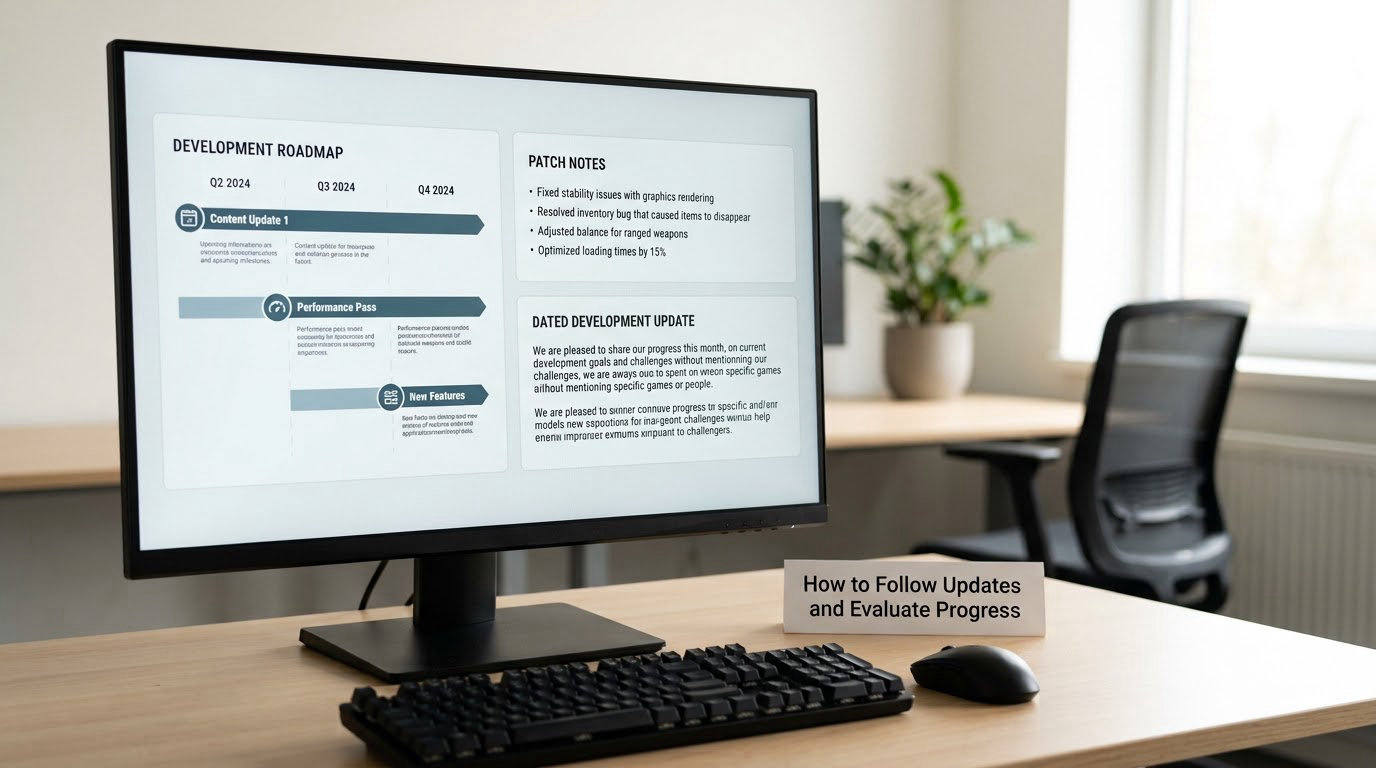
Every serious early access game publishes the same handful of things. Find them once and you can judge any project.
The store page carries the description, the current feature list and the roadmap. Read the description for what is explicitly missing, because well-run studios list omissions plainly. Treat the roadmap percentage cautiously. Studios use it loosely, some estimate generously, and a static percentage tells you nothing about what happened last month.
The update feed is the real signal. It is dated, public and impossible to fake retroactively. Look for the interval between updates, whether notes explain the reasoning behind balance changes, and whether previously promised items actually appear.
The developer channel, usually a Discord, forum or devlog, shows whether a real team is still answering questions. Check the date of the most recent substantive post rather than the most recent message, because a busy channel can be nothing but argument about server population.
Finally, watch review trends rather than review totals. A game whose recent reviews are mixed while the total looks fine usually has a specific recent grievance. Read the last month, not the aggregate score.
What Are the Main Risks of Buying Early?
- Missing features. Systems can be absent entirely, or present as placeholder content that will be replaced later.
- Bugs and performance. Crashes, frame drops and unstable multiplayer are common in early builds and usually improve, but not always quickly.
- Balance changes. The build you bought may be fundamentally reworked. A class that feels weak today may be the strongest one after the next patch.
- Delayed or moved features. Roadmap items slip and occasionally vanish as scope grows or funding tightens.
- Save resets. Major updates can wipe or restructure progress, as covered above.
- Abandonment. A studio can close, lose funding or simply lose interest. The game then stays exactly as unfinished as it was on the day development stopped.
- A different finished game. The 1.0 release can look and play quite unlike the build you bought. This is the risk players complain about most, and it is not a rule violation.
- Price change. Leaving early access usually raises the price, which can sting if you bought late and played little.
The abandonment point deserves emphasis because it is the one nobody can rule out. Forum discussion about early access keeps circling this, and players regularly recommend refunds after a launch build underdelivers on its own store page. No platform guarantee replaces a studio that is still shipping.
Is Early Access Worth It?
It depends on the genre you are buying and how you feel about bugs. There is no single correct answer, and the honest version has two halves.
Early access tends to suit players who enjoy watching a system grow, who are happy reporting bugs, and who can accept a save being invalidated. Simulations, factory builders, physics sandboxes and roguelikes are built in ways that benefit from years of additions, so early access is a good fit there. If you enjoy reading patch notes more than reading reviews, you will probably have a good time.
Waiting suits players who want one fixed experience, who dislike unfinished systems, or who prefer a story with an ending. Linear narrative games gain very little from months of open iteration, because the structure cannot change without rewriting everything, and players of those games are the loudest opponents of the model. If you care most about a story, save files or a stable frame rate, wait for 1.0.
One practical middle path works well. Buy only when the description lists no dealbreaker for you, the current build already contains the activity you would play for, and the developer has a visible record of shipping what they said they would. Otherwise, put it on a watch list and check the update feed once a month. Nothing about early access requires you to decide today.
Frequently Asked Questions
Is an early access game usually cheaper than the full game?
Most are sold below the planned retail price, and many raise that price when they reach 1.0. The gap varies by studio, and regional pricing means your discount may differ from someone else’s. Some developers bundle extra content into the early access version instead of discounting heavily. Check the store page for the current figure, and judge it against the build you would be buying today rather than the finished version.
Why do early access games change so much after you buy?
Because players are part of the testing process. Updates routinely add features, fix crashes, rework interfaces and shift balance, which can alter what seemed like a weak or strong choice. A build sold as a paid beta is expected to change shape, sometimes substantially, before it reaches 1.0. If your purchase depends on one specific system staying unchanged, early access is the wrong route.
Do developers have to finish every feature on the roadmap?
No. Roadmaps are intentions rather than contracts, and studios regularly reorder, delay or drop items as scope changes or funding shifts. Valve requires developers to describe their goals clearly, but nothing obliges them to deliver every listed feature. The signal worth trusting is past behaviour: check whether earlier promised items actually appeared in the update feed on roughly the schedule that was promised.
Can an early access game be abandoned before full release?
Yes, and nothing prevents it. Studios close, run out of funding or lose interest, and the game simply stays in whatever state the last update left it. Some games are also meant to stay in early access permanently as an evolving product, which is a different situation from a stalled project. Regular dated updates and an active developer channel are the best early warning that work is still happening.
Should I buy an early access game on launch day or wait?
Waiting is the lower-risk choice, and waiting a few months usually costs you very little. You get bug reports from other players, a clearer view of update pace, and a build closer to what you would have paid full price for at 1.0. Buying on day one makes more sense if the current build already contains the systems you want and you want to shape the roadmap. Either way, check the refund policy first.
Conclusion
How early access games work comes down to one trade: you pay earlier and take part of the development risk so the studio can keep building. Everything else, roadmaps, discounts, refund exceptions and save wipes, follows from that arrangement.
Before you buy, do four things. Play a demo or watch recent reviews to see how the build actually runs. Read the last two or three update notes rather than the store description. Check whether the roadmap has moved recently and whether the developer is still answering questions. Then read the refund policy for your region and platform.
If the current build lacks the core experience you would be paying for, wait. The 1.0 release is not going anywhere, and a few months of waiting usually costs you less than it saves you.