Why user reviews and critic reviews disagree comes down to the measurement system, not the mood of the crowd. Critic scores come from a vetted pool of professional writers who must publish a graded review. User scores come from anyone with an account. Different reviewers, different criteria, different amounts of time with the game — and a different number.
I’ve watched people argue about this for years on forums, and the argument almost always goes sideways fast. One side says critics are bought, the other says players can’t tell craft from fun, and neither side ever gets to the part that actually explains the gap.
So here is the honest version: neither number is lying to you, and neither one is built to answer the question you’re asking when you look at it.
Table of Contents
- 1Why User Reviews and Critic Reviews Disagree
- 2How Patterns Show Why User Reviews and Critic Reviews Disagree
- 3What User Reviews Measure That Critics May Miss
- 4What Critics Measure That User Reviews May Miss
- 5How Hype, Refunds, and Expectations Shape Both Scores
- 6Does a Higher Review Score Mean a Better Game?
- 7Which Reviews Should You Trust Before Buying?
- 8Frequently Asked Questions
- 9Why is the critic score so much higher than the user score?
- 10Can user reviews be unfair because of review bombing?
- 11Why do players in different countries give a game different ratings?
- 12Are critic reviews better for judging an indie game?
- 13Should I reconsider a review after a major patch?
- 14Use Both Reviews to Make a Smarter Choice
Why User Reviews and Critic Reviews Disagree
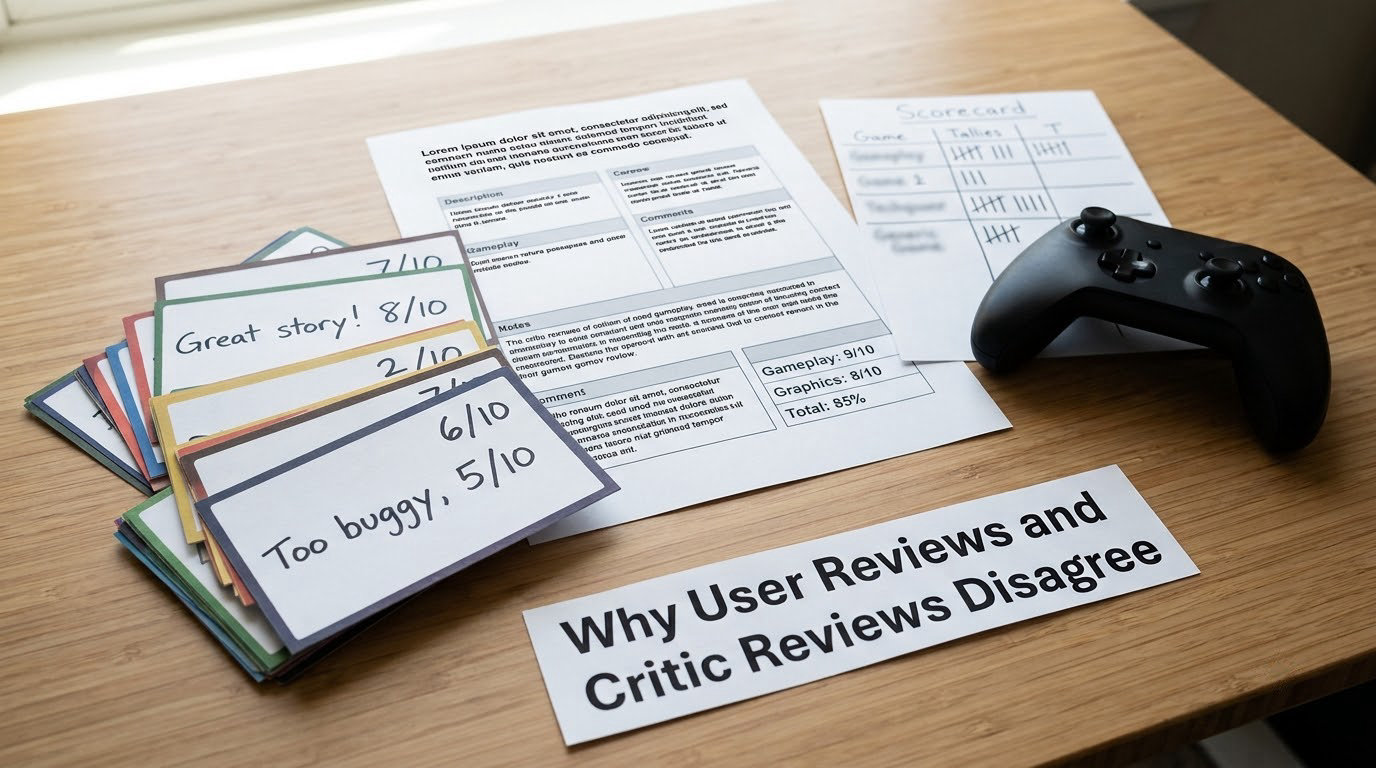
Critics assess a game against artistic and technical standards, and they do it with the whole history of the genre in mind. User reviews usually capture something simpler: did this hold my attention, did it run on my hardware, and was it worth the hours. When those two jobs get averaged into one row on a page, the disagreement is baked in before anyone types a word.
| Factor | Critic review | User review |
|---|---|---|
| Who is writing | Approved critics at established outlets | Any account holder, often bought or never played more than an hour |
| What gets judged | Craft, originality, pacing, technical execution | Enjoyment, bugs, value, whether it matches expectations |
| Time on the game | Days to weeks, often on a pre-release build under embargo | Anything from ten minutes to a full completion |
| Stakes and incentive | Traffic, reputation, access to the next review copy | Venturing, signalling, arguing a point in a thread |
| Typical length | 800 to 2000 words | One sentence and a number |
| Sample size | Often 30 to 90 scored reviews | Hundreds or thousands, heavily weighted by outrage |
That table is really the whole argument. One column is a slow, supervised, written analysis. The other is a fast, open, unmoderated tap of a button.
How Patterns Show Why User Reviews and Critic Reviews Disagree
Once you know what each side is measuring, the recurring patterns stop looking mysterious. Aggregate ratings, review bombs, early-access entries and the difference between a specialist reviewer and an average player each bend the user score in a predictable direction.
| Pattern you see | What it usually means |
|---|---|
| User score far above the Metascore | The audience bought in and liked it; critics found flaws in craft or originality |
| User score drops hard a few weeks after launch | Refunds and buyers who hit bugs started writing, which cools the launch-week average |
| Sudden spike in one-star reviews on one platform | Organised campaign or a hardware-specific defect, not a verdict on the whole game |
| High score with only a handful of critic reviews | Indie or pre-release coverage; small sample on one side of the row |
| Critic score with no user score, or vice versa | Too few scores in that category to display, which tells you something useful |
| User score climbs after a large patch | The thing people complained about got fixed, and the reviews reflect the fix |
One forum example sticks with me. A thread on r/CrimsonDesert was debating a 77 Metascore sitting next to a much higher user score, and almost nobody in it was asking about the game’s quality. They were asking why the two numbers could exist in the same row. That’s the right question.
What User Reviews Measure That Critics May Miss
Player feedback is closer to the actual lived experience of a game than any review essay. Nobody writing a critic piece is holding your controller at 11pm on a work night.
- Whether it runs on your setup. Console performance, frame pacing and crashes get reported by thousands of people within a week of launch, often before a review embargo lifts.
- Long-term friction. Repetitive grinds, terrible tutorials and confusing menus are painfully obvious after thirty hours and nearly invisible at twenty.
- Community health. Whether matchmaking works, whether the chat is hostile, whether a solo queue is viable — critics rarely sit in that environment long enough to judge it.
- Accessibility barriers. Colourblind modes, remapping, text size, controller remaps. Players who depend on these will tell you exactly where the defaults fail them.
- Value over time. Content volume, replayability and how the game holds up after the credits. A short game that respects your weekend can beat a fifty-hour epic in a user’s book.
- Platform and genre fit. Whether this suits the console you own, or whether you want a shooter at all. Critics rate the work; buyers rate the match.
None of that is trivial. A beautifully designed game that stutters on your television is a bad purchase, and only people who actually own that television can tell you.
What Critics Measure That User Reviews May Miss
The professional side wins on things that only become visible after you have finished a game, or after you have played ten more in the same genre.
- Originality. Whether the core loop is borrowed, rearranged or genuinely new. Players notice if a game is fun; critics notice if that fun already existed somewhere else.
- Mechanical depth. Whether the systems interlock or whether the variety is a menu of shallow modes stacked on one engine.
- Pacing and structure. A reviewer can call out a weak third act without spoiling it, because the criticism is about shape, not outcome.
- Technical execution. Frame rates, load times and control feel tested across settings on hardware most players don’t own.
- Difficulty balance. Whether a game is hard because it’s demanding or because it’s confused about its own rules.
- Context. A critic can place a release against everything else in the same month and genre. Your own comparison set is whatever you happen to have played.
Expertise sharpens the analysis. It does not remove taste, and a critic who loves Souls-like design will always describe a good Souls-like game more generously than you might.
How Hype, Refunds, and Expectations Shape Both Scores
Scores move before anyone finishes evaluating the work. Marketing sets the reference point, launch week sets the mood, and the refund window quietly decides who gets to complain later.
A game announced as a ten-year journey arrives carrying an expectation nobody had to earn, and a solid but ordinary release reads as a disappointment. Critics writing on launch day are also writing against a marketing budget’s worth of narrative that they did not choose.
Players behave differently because of the refund window. Someone who bought on day one and bounced in three hours is a refunder, and refunders are far more likely to leave a furious one-star review than a quietly satisfied buyer is to leave a five-star one. The people who loved it kept playing all weekend and never opened the review box.
Early access makes this stranger still. An incomplete build produces a mix of feedback that is technically accurate and completely misleading if you read it as a verdict on the final release.
Then there are campaigns. Review bombing is real and it runs both ways: fans punishing a studio over a business decision, and organised squads inflating a score for a game they never bought.
One distinction keeps this readable. Criticism of the game is information. Criticism of the developer, the publisher or a console war is a mood. Sorting those two apart does more for your buying decision than any aggregate score.
Does a Higher Review Score Mean a Better Game?
No, and the two numbers were never competing for the same job. A higher score tells you something about how a group of people felt under specific conditions, and those conditions differ on every side.
| Question | Critic score | User score |
|---|---|---|
| What is the average | Weighted mean of graded reviews, normalised to 0-100 | Mean of star or thumbs ratings, sometimes recency-weighted |
| Typical volume | Tens of reviews per title | Hundreds to hundreds of thousands |
| Common ground | Craft and technical quality | Whether the game runs and holds attention |
| Biggest bias risk | Access, embargo timing, house style, relationship with publishers | Outrage, fandom identity, refunded buyers, organised campaigns |
| Strongest use | Predicting the general shape of the experience before you spend anything | Predicting whether you personally will enjoy and tolerate it |
Research cited by outlets covering this topic, published in the Journal of Consumer Behaviour, found that a 10% increase in review score lined up with an 18% increase in sales among more experienced players. That is about commercial impact, not about who is right.
Same study, useful detail: consumers write more than twice as many reviews as professionals, but their scores vary wildly. Critics are not necessarily more accurate — they are more consistent. Consistency is what an aggregate actually needs.
Which Reviews Should You Trust Before Buying?

Trust is the wrong verb here. Read the numbers for what they can support, then ignore them where they have nothing to say.
- Read the breakdown, not the badge. Open the individual critic reviews. A 70 built from one respected outlet and six generous ones is different from a 70 built from broad agreement.
- Check the review count and the ratio. A score built on nine critics tells you far less than the same number from sixty. Very large user counts are reassuring for bugs, less so for taste.
- Filter to your platform. Scores and reviews separate by console and PC, and often by region. If you are buying the console version, ignore PC performance chatter.
- Sort by recent, not all-time. Early reviews describe a build that may no longer exist. Recent reviews describe the version you can actually buy.
- Separate bugs from dislike. Read the one-star reviews closely. Repeated, specific complaints about the same mechanic are signal; vague fury is usually about something else.
- Look for problems named more than once. Three reviewers independently describing the same difficulty spike means something. One angry post does not.
- Find a critic whose taste matches yours. This is the most useful habit here, and it beats any aggregate. Follow one reviewer for your favourite genre and weight their verdict heavily.
For how often you play and how much you care about craft, start with critics. For whether it will run, whether it respects your time, and whether people like you are enjoying it two hundred hours in, start with recent user reviews.
One score-reading note on Metacritic specifically, since it confuses people constantly: the Metascore bands run roughly 90 and up for Must-Play, 80 to 89 for Great, 70 to 79 for Generally Favorable, 40 to 69 for Mixed, 20 to 39 for Unfavorable, and under 20 for Poor. A 72 and a 76 are effectively the same verdict, and the gap between a 72 and a 68 is noise.
Also worth knowing: some well-regarded outlets publish no numeric score at all. Any Metascore is therefore an incomplete sample of professional criticism, and reading it as the final word on critical opinion is a mistake.
Frequently Asked Questions
Why is the critic score so much higher than the user score?
It usually means the audience and the critics value different things. Common cases include a game that is plain fun but conventional in design, a sequel that fans asked for specifically and got, or a divisive story that rewards attention and frustrates anyone playing casually. Critics also write inside a genre tradition and often judge a game against its peers, while users usually judge it against the promise in the trailer.
Can user reviews be unfair because of review bombing?
Yes, and it happens often enough that most aggregators now ship detection for it. Coordinated one-star campaigns are common when a studio makes a business decision fans dislike, and coordinated five-star campaigns happen too. Signs of a manipulated score include a tight cluster of identical ratings arriving within hours, a wave of reviews on a platform the players are not on, and complaints about a studio decision rather than the game itself. Steam flags some of this with an off-topic notice on individual reviews.
Why do players in different countries give a game different ratings?
Regional scores differ because the people buying are different. Pricing, release timing, regional servers, language support and local payment methods all change who ends up playing. A title that struggles with a regional server or ships with badly translated text will collect angry ratings from that region and quiet ones everywhere else. On big multi-platform releases the platform split can be just as sharp, since a Switch or handheld audience is scoring a different build.
Are critic reviews better for judging an indie game?
It depends on coverage. Small indie titles often get only a handful of critic reviews, sometimes from outlets that do not assign numeric scores, so the Metascore can rest on two or three opinions or not exist at all. In that situation the user side is often more informative, especially about bugs and value. For an indie game with broad coverage, the critic side still tells you more about design originality and structure than a star rating can.
Should I reconsider a review after a major patch?
Often, yes, and both scores deserve a second look. Large patches change performance, difficulty, progression and sometimes the economy of the game entirely, so a critic score written on the launch build can describe a version that no longer exists. Check whether recent user reviews have climbed, whether reviewers named the problems that got fixed, and whether the patch notes match the complaints. Read the updated version as a separate product.
Use Both Reviews to Make a Smarter Choice
Start by writing down what would actually ruin the game for you — a slow combat system, a bad controller port, a ten-hour commitment. Then check which score is even capable of answering that.
Critic analysis tells you the shape of the thing. Recent user evidence on your platform tells you whether the shape survives contact with your hardware and your schedule. Together they cover nearly everything, which is the practical answer to why user reviews and critic reviews disagree: they were never duplicating each other, so you should not be using either one twice.