
A user generated content platform is the software layer that collects content made by real people, checks it for quality and safety, records permission to use it, tags and stores it in a searchable library, and then serves it back to a website, app, ad campaign or community feed through an API or an embedded widget. The same pipeline powers review marketplaces, fan communities and player-made content hubs in games.
Understanding how user generated content platforms work comes down to five questions: where the content comes from, who checks it, how permission is handled, how people find it later, and what happens to it when the community moves on. This guide walks through each one, with a few examples from gaming communities and fan-driven multiplayer projects.
Table of Contents
- How User Generated Content Platforms Work
- What Is User Generated Content?
- How Does the User Generated Content Lifecycle Work?
- Why Platforms Use Contributions, Ratings and Rankings?
- How Do Creators Earn Visibility or Rewards?
- Who Creates and Reviews the Content?
- How Does Moderation Protect a Community?
- How Do Platforms Personalize What Users See?
- What Data Do These Platforms Collect?
- Why Do User Generated Content Platforms Fail?
- What Makes a User Generated Content Platform Work Well?
- Frequently Asked Questions
- Conclusion
How User Generated Content Platforms Work

The short version of how user generated content platforms work
The pipeline runs in a fixed order, and each stage exists because the one before it creates a problem the next one solves. Raw submissions arrive faster than anyone can read them, so automated checks screen the flood before a human ever sees it. Humans then make the judgment calls that rules cannot. Every approved piece of content gets tagged, because a library nobody can search is a library nobody reuses.
Permission sits alongside moderation rather than after it, since the platform asks for usage rights at the moment content is submitted instead of chasing consent months later. Once content is cleared and tagged, it lives in one library that many surfaces read from: a product page, an email, a loading screen, a tournament broadcast.
Where player-made content fits the same pattern
Gaming platforms run this exact cycle at a larger volume than most marketing tools. A player builds a custom level in an editor, submits it to a workshop, and waits while automated checks scan the files and community reviewers look for anything broken or copied. If it passes, it gets a page with a title, description, thumbnail, vote count and a comment thread.
That workshop page is the library. Search, sorting and ranking all read from it, and so do discovery features elsewhere in the game. When a piece of content gets pulled for a rights complaint or a broken update, the platform can remove it from every surface that surfaced it, which is something a reposted screenshot can never do.
What Is User Generated Content?
User generated content is anything a person outside the official team made and published: a player-made map, a strategy guide, a forum answer, a screenshot, a video, fan art, a community-run tournament, a bug report with reproduction steps.
What counts as user generated content
The test is authorship and audience, not file type. Official cinematics and patch notes are excluded because the team owns and schedules them. A player’s video walkthrough of the same update is included, because the player made it for other players.
Categories map cleanly onto platform features. Text contributions include forum threads, reviews, questions and answers, which run on text search, voting and comment threading. Visual contributions include screenshots, photos, artwork and short clips, which run on galleries, tagging and image delivery. Video contributions run on a player, a transcoding pipeline and a watch counter. Structured contributions like ratings, star scores and difficulty votes run on aggregation, so a single number summarizes thousands of votes.
Community events count too. A player-organized tournament with its own rules page is user generated content even though nobody uploaded an asset to it.
How Does the User Generated Content Lifecycle Work?
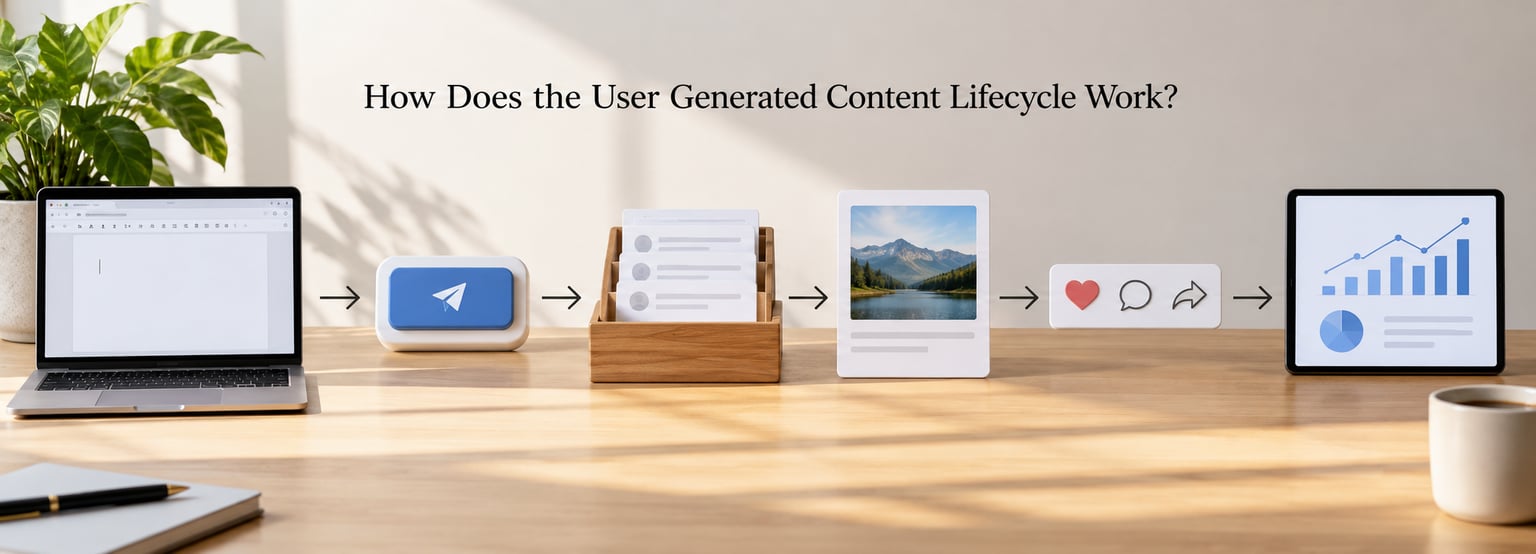
Seven stages carry content from a raw file to a measured result. Most platforms implement them in the same order, even when the stage names differ.
The seven stages from submission to measurement
1. Creation. Someone writes, records or builds the content in a tool that may live on the platform itself or somewhere else entirely, like a modding kit or a community editor.
2. Submission. The contributor uploads it, fills in metadata such as title, description, category and tags, and grants or withholds usage permission. This is where the platform captures consent.
3. Automated screening. File scanners check uploads for malware, prohibited media and spam patterns. Classifiers score text and images for abuse, harassment and unsafe material, routing uncertain cases onward rather than deciding alone.
4. Human review. Moderators work a queue, approving, requesting changes or rejecting with a reason the contributor can read. The reason matters, because a rejection without one teaches nobody anything.
5. Storage and enrichment. Approved content moves into the asset library with its metadata, and AI tagging adds categories, objects and sentiment that humans did not type. Images get resized, video gets transcoded into web-ready versions, and thumbnails get generated.
6. Delivery and discovery. The content appears wherever the platform is wired up: feeds, search results, product pages, ads, emails, leaderboards, in-game menus. Read systems usually pull pre-built views from a cache rather than querying live.
7. Measurement. Views, votes, completion rates, saves, outbound clicks and conversions flow back to an analytics dashboard and to the contributor’s own stats, which is what keeps people contributing.
How a platform collects content
| Collection method | What it captures | Where it strains |
|---|---|---|
| Hashtag and mention monitoring | Public posts that use a campaign hashtag or tag the account | Social networks restrict what search tools can retrieve, so coverage is incomplete |
| Direct contributor submission | Anything a person uploads through a form or widget | Volume stays low unless something outside the platform prompts people |
| In-platform creation | Reviews, ratings, comments, answers and posts made on the platform itself | Requires a destination people already visit |
| API and syndication | Approved content shared across a network of brands, retailers or game titles | Rights differ per partner, so permissions need per-destination tracking |
Marketers who work with this daily report that the tooling is not what drives volume. A clear ask plus a branded hashtag does that part; the platform just makes the results usable.
Why Platforms Use Contributions, Ratings and Rankings?
Ranking systems solve a problem that appears the moment a library passes a few hundred items. Without ordering, the newest submission buries the guide that has been helping people for three years.
Signals usually combine engagement, freshness and context. Votes from accounts with history carry more weight than votes from brand-new ones, and a piece of content that keeps getting saves signals usefulness even if it never tops the chart. Search relevance pulls in text matching, tags and category, which lets an old post surface for a query it fits better than a newer one.
Popularity is a routing signal, not a verdict. It tells a platform who to show first, and a human or a quality score decides who stays. Confusing the two is the most common design mistake in the category: platforms that surface whatever got the most votes tend to fill with drive-by spam until someone cleans it up.
Leaderboards also shape behavior. Tie contributions to activity and they get finished, documented, tested entries. Tie them to raw post counts and you get padding.
How Do Creators Earn Visibility or Rewards?
Most contributor programs mix three things: visibility, status and something tangible. Follower counts and follower feeds are the cheapest to run and the most motivating for people who want an audience. Badges and reputation unlock features rather than pay out, which keeps a community’s economy out of cash entirely.
Then there are contests, where a theme and a judging method are published up front, and revenue sharing, where a share of what the content earns flows back to the contributor. That last one needs a lot of plumbing, including attribution that survives caching and syndication.
The part platforms get wrong is eligibility rules. If people cannot tell in advance which activity counts, they stop bothering. Clear rules beat generous ones here, and the rules should cover what happens when a post is removed after earning credit.
Who Creates and Reviews the Content?
Five groups touch a UGC platform, and the mix shifts with scale. Creators are the obvious one, but community members who comment, vote or fix a broken link are contributors too, and platforms that only count posts lose them.
Volunteer moderators absorb the volume that no paid team could read. They are the reason big forums survive, and they are also the reason burnout is the top reason moderator teams shrink. A platform with a moderation pipeline but no recognition for its reviewers is running on borrowed time.
Automated systems handle the repetitive screening described earlier. Platform employees handle the appeals, the legal complaints and the edge cases where a rule does not obviously apply.
Human review stays necessary in specific places even with good classifiers. Context-heavy cases, appeals after a takedown, and anything involving a rights holder are judgment calls.
How Does Moderation Protect a Community?
Moderation is what separates a functioning community from one that turns into a spam pit. Platforms combine six approaches, and most run them together.
The stages of moderation in practice
Pre-publication review holds content before anyone sees it. It catches the large volume of junk, but it also slows down genuine contributions, which is why high-volume platforms review most content automatically and send only the uncertain fraction to a queue.
Post-publication review catches what slipped through, usually through user reports. Report volume is a signal in itself, and a spike in reports on one item is treated as more urgent than many reports spread across many items.
Spam and abuse controls cover link flooding, duplicate posts, sockpuppet voting and coordinated brigading. These are pattern problems, so automation does most of the work.
Copyright and rights complaints run through a dedicated channel, usually with a form that captures the work, the claimant and the URL. The platform needs a repeat infringer policy, or the queue never clears.
Behavioral rules cover harassment, discrimination and off-topic posting, and they apply to veteran contributors exactly as they do to newcomers. Consistency is what makes a code readable.
Appeals and graduated enforcement mean a warning precedes a removal, which precedes a suspension, which precedes a ban. Publishing the ladder in advance tells people what happens next, and it reduces the number of angry messages.
None of this is identical across platforms. A private guild forum and a public review site have completely different risk profiles, and the same rule can be sensible in one and absurd in the other.
How Do Platforms Personalize What Users See?
Personalization splits into two systems that people often confuse. Filtering is what you do explicitly: follow a creator, subscribe to a category, hide a tag, mute a thread. The result is predictable and under the reader’s control.
Recommendation is the other half. A ranking model scores each candidate post against the reader’s history, what similar readers opened, and what the post itself is about. Feeds built this way change without anyone deciding they should, which is exactly why platforms disclose how ranking works and give people a way to opt out of being ranked.
For creators, the practical implication is that a post can be excellent and still sink, because distribution is now a function of match rather than seniority.
What Data Do These Platforms Collect?
The usual categories cover more than people expect. Account data includes profile details, join date, verification status and linked identities. Content data includes everything submitted, plus its metadata, tags and moderation history. Interaction data covers votes, reactions, comments, follows, saves and shares. Technical data records device, browser, IP address and session logs. And then there is message data for anyone with private or forum communication.
Privacy notices matter here for a practical reason: contributors are handing over a permanent piece of work and often a likeness. Retention policy decides what happens to it. Does an account deletion delete the media, or does the content stay while the profile goes? Platforms that answer that question clearly are easier to contribute to, and the answer belongs in the terms rather than in a support article.
Why Do User Generated Content Platforms Fail?
The failure modes repeat, and most are design decisions rather than technical faults.
Weak incentives. People contribute, get nothing measurable, and stop. Activity that produces no visible return dies quietly.
Moderation that cannot keep up. Once the queue outpaces the reviewers, the library fills with junk and the good contributors leave first.
Confusing rules. Ambiguous terms about what is allowed turn every moderation decision into an argument, because there is no shared standard to appeal against.
Ranking by raw popularity. Spam wins, because spam is optimized for engagement. This is the single most common way a young platform breaks.
Moderator burnout. Volunteer teams carry the load with no relief valve. When key moderators leave, the platform usually declines within weeks.
Toxic behavior that goes unaddressed. A few bad actors can poison a whole section, and the damage spreads faster than the fix.
Legal disputes over rights. Content used without recorded consent creates liability that surfaces long after the campaign ends.
Artificial engagement. Bought votes make the ranking signals useless, and once a community notices, the numbers stop meaning anything.
An inactive core. A platform needs a group that shows up even when nothing is happening. Without that, every feature has to work harder.
What Makes a User Generated Content Platform Work Well?
Judge any platform on seven things. Clear rules come first, published where contributors actually read them and written in plain language. Useful discovery follows, meaning search, categories and filters that find useful material in a couple of clicks rather than burying it under whatever trended last week.
Fair moderation means published rules, a visible queue status and an appeal route that gets a human answer. Contributor recognition keeps people contributing, through credit that survives syndication and a progression system that reflects real work.
Accessible tools matter more than clever ones. An upload form that works on a phone, survives a dropped connection and asks for metadata once will outperform a studio-grade editor that only runs on desktop.
Reliable performance is the quiet one. If pages stall or uploads fail intermittently, creators stop submitting and nobody sends an email about it, they just stop.
Healthy participation is the hardest thing to fake and the best predictor of survival. Look at whether a small group of people post consistently, whether newcomers get replies, and whether the rules are applied the same way to everyone. That pattern tells you more than any feature list.
For anyone weighing a platform for their own community, start with contribution quality, moderation practice and discovery. Get those three right and the rest is tuning.
Frequently Asked Questions
Are all user generated content platforms moderated?
Nearly all of them, but the depth varies a lot. Large public platforms rely on automated classifiers to screen most submissions and send only the uncertain fraction to a human queue. Small private communities often do the opposite, with every post read by a person before it appears. The gaps show up in the places you would expect: gaming platforms where automated file scanning catches broken uploads but human review still handles harassment reports, and review sites where a mix of both filters the bulk of low-quality submissions.
How do platforms decide which user submitted content to feature?
Feature decisions are almost never made by hand alone. Platforms score each submission on engagement, freshness and topic relevance, then boost contributions from accounts with established history and from pieces that keep earning saves or replies over time. Editors and curators add a manual layer on top for launches, spotlight pieces and anything commercially important. Popularity routes attention, but a quality or relevance check decides who stays in front.
Can anyone make money on a user generated content platform?
Some can, most do not. Payment usually arrives through one of four routes: a flat fee for a commissioned piece, a contest with published judging rules, a revenue share tied to how content performs, or a subscription-style arrangement where a supporter pays the creator directly. Contributors with an audience or a specialist skill fare best. Platforms rarely pay for ordinary participation, and the ones that do typically require an application rather than handing out money automatically.
What is the difference between user generated content and creator content?
The difference is who commissioned it and who gets paid. User generated content comes from a community member publishing for other community members, with no brief and no payment. Creator content, sometimes called paid UGC, is made by someone a brand hired to produce material the brand then uses in its own marketing. The audience often cannot tell the difference, which is exactly why platforms ask contributors to disclose commercial relationships and why sponsored posts carry labels.
How can new contributors get their work noticed?
Publish where the search function actually works, because most readers arrive through search or a recommendation rather than browsing. Titles and descriptions should match the words people would type, and adding accurate tags helps more than a clever headline does. Answering an open question in the community is often faster than posting an original piece, because the request already has an audience waiting. Consistent small contributions also carry further weight than one large post that disappears in a week.
Conclusion
Every user generated content platform runs the same cycle. Contributions arrive, machines screen them, people judge them, permission gets recorded, the cleared material lands in a searchable library, and ranking decides who sees it. Analytics then tell the community whether any of it mattered, and that signal is what brings people back to contribute again.
Before you join one or launch your own, look at three things: the quality of what is already published, how the moderation queue actually works, and whether you can find anything you know exists. Those three answers tell you more than any feature list. If a platform cannot show you a working search, it cannot show your work to anyone either.